Ontology
Project Context
Reinforced concrete gravity retaining walls used for chemical containment are safety-critical civil engineering systems designed to prevent the uncontrolled release of hazardous liquids. Unlike conventional soil-retaining walls, these structures function as secondary containment barriers around storage tanks and industrial facilities, where they must remain liquid-tight, structurally stable, and resistant to chemical attack under hydrostatic loading conditions.
Objectives
The objective of this project was to develop an ontology-based representation of a reinforced concrete gravity retaining wall system used for chemical containment. The ontology formalizes the wall’s structural components, material systems, containment functions, and safety-related features in order to support systematic design reasoning, comparison of design alternatives, and compliance with environmental and safety requirements.
Modelling Approach
An ontology was developed using OWL-based modelling principles to represent the retaining wall as an integrated system composed of wall stem, mat foundation, reinforcement, joints, waterstops, protective coatings, and geometric detailing. Logical relationships were defined using object and data properties, with appropriate domains, ranges, and characteristics such as inverse and transitive properties. Parametric attributes including wall height, thickness, reinforcement layout, foundation dimensions, chamfers, and containment use were encoded to enable structured reasoning and evaluation of different design configurations.
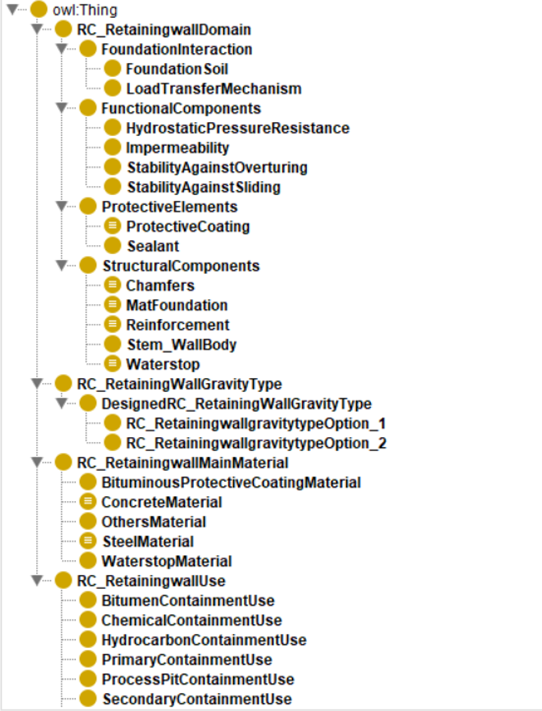
Figure 1: Class hierarchy
Key Outcomes
The ontology enables reinforced concrete containment retaining walls to be represented as knowledge-based design alternatives rather than isolated structural elements. It supports comparison of structural configurations, material choices, and detailing strategies under varying containment and foundation constraints, while maintaining logical consistency and alignment with engineering design practice.
Relevance & Future Potential
This work demonstrates the applicability of ontological modelling to environmental protection and industrial safety infrastructure. The framework provides a foundation for integration with parametric design tools, structural analysis workflows, and BIM-based coordination, with future potential to support automated compliance checking, optimization of material usage, and life-cycle performance assessment.
Parametric Model
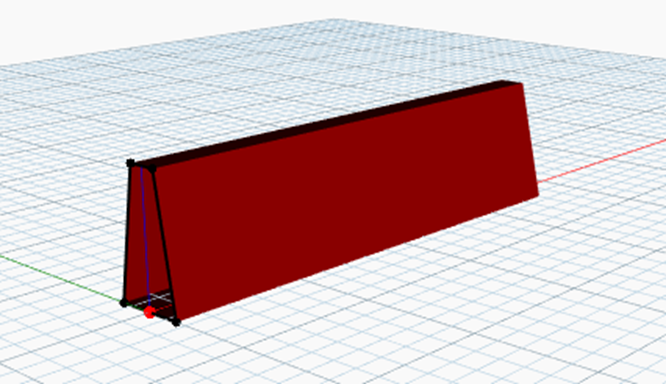
Figure 2: Parametric model of the Reinforced Concrete Gravity Retaining Wall
This project presents a reinforced-concrete retaining wall developed as a parameter-driven system for containment and environmental protection applications. The wall geometry is defined through a two-dimensional section that is extruded into three dimensions, allowing the overall form to adapt directly to changes in key design inputs.
The model focuses on how variations in wall height, base width, heel length, and stem thickness influence stability, footprint, and material usage. Adjusting these parameters automatically updates the wall geometry, making it possible to observe how small dimensional changes affect the balance between safety and concrete volume.
Rather than relying on fixed proportions, the system enables rapid generation of alternative wall configurations. This allows designers to explore material-efficient, stability-focused, and balanced solutions and to understand the geometric trade-offs inherent in reinforced-concrete retaining wall design.
The project demonstrates how parametric modelling can support early design exploration by making structural relationships and trade-offs visible through direct interaction with the model.
Documentations
Home | Introduction | Individual Systems | Integration Context | Combined Ontology | Combined Parametric Model