The integrated context of this project focuses on emergency water supply for a single building. Several infrastructure systems interact to improve resilience at the building scale. These systems include on-site water storage, external water supply connections, internal and external distribution networks, and road infrastructure for emergency delivery.
The building acts as an emergency water demand and distribution point. Water can be supplied through the pipe network connected to the building or delivered by trucks using the road system. An elevated water tank provides on-site redundancy and allows water supply to continue when the main supply or distribution system is disrupted.
Rather than analyzing systems independently, this project evaluates their interactions and combined contribution to ensuring reliable water supply to the building during emergency scenarios.
| 5 Storey Building | Elevated concrete water tank | Small scale water supply system | Road | Water distribution network | |
| Input | -Area-No. of Stories | -Container Diameter, Depth | -tank diameter-tank height | Width/ Lanes | -pipe diameter-wall thickness-pipe length |
| Output | Demand | Volume/Capacity | -Capacity | Number of Cars | -area-volume-capacity |
Engineering Challenge
The main engineering challenge of this project is defined as:
How can reliable and resilient water supply to a building be ensured during emergency conditions while maximizing performance relative to cost?
This challenge involves addressing several key issues
- Meeting high and variable water demand during emergencies
- Providing redundancy in water supply and storage
- Maintaining system functionality under partial infrastructure failure
- .Balancing system capacity, resilience, and economic efficiency
High Performance Criteria
The performance of the integrated system is evaluated using the following criteria:
- Water Availability: The amount of water that can be supplied during emergency conditions
- System Redundancy: The number and quality of independent supply and delivery pathways
- Performance per Cost: Water delivery capacity relative to required infrastructure and resources
- Reliability: System performance under failure or disruption scenarios
- Operational Accessibility: Accessibility for maintenance, emergency response, and logistics
These criteria enable comparison of alternative design options and assessment of system resilience.
Role of Individual Systems
Critical Building
- Represents city-scale water demand
- Acts as the end-user and emergency coordination point
- Serves as the reference point for system performance evaluation
Water Supply System
- Provides the primary external water source.
- Supplies baseline flow to the distribution network and storage
Elevated Water Tank (Storage System)
- Provides on-site emergency water storage.
- Enhances system resilience and service continuity.
- Supports short-term demand during supply interruptions.
Water Distribution Network
- Transfers water from supply and storage to the building.
- Defines hydraulic and capacity constraints.
Road Infrastructure / Trucking
- Provides an alternative emergency delivery method.
- Supports water delivery when pipe-based supply is unavailable.
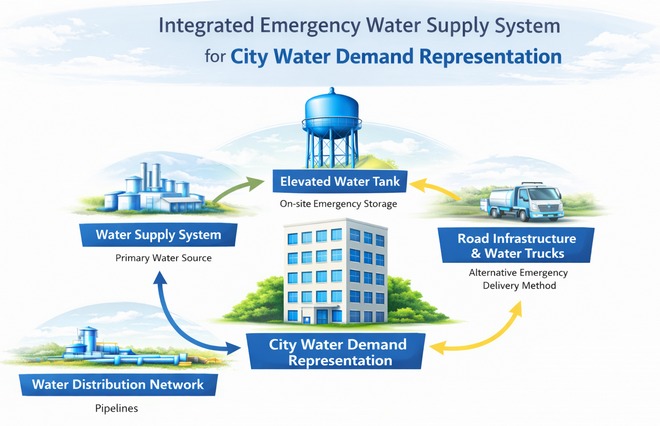
Figure 2. Integrated emergency water supply system for a city, represented by a building proxy, showing the interaction between the primary water supply, elevated storage, distribution network, and emergency truck-based delivery. Derived from ChatGPT.
Table 2. Functional relationships within the integrated emergency water supply system
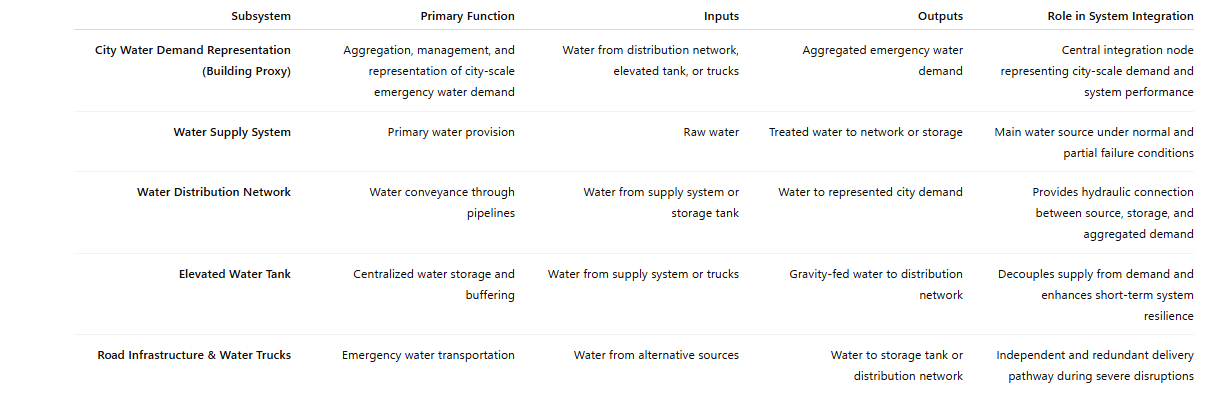
Here, Functional relationships among integrated subsystems in the emergency water supply system, where the building is used as a proxy to represent aggregated city-scale water demand and system performance.
Ontology & Parametric Model Integration
To address the engineering challenge, the ontology and parametric models are deliberately simplified and reorganized. The ontology focuses only on the concepts, classes, and relationships that are directly relevant to water demand, supply, storage, and distribution at the building level. Details from individual subsystems that are not essential to this analysis are removed to ensure clarity and consistency in how the systems are integrated.
In the parametric model, building water demand is treated as a shared variable across all connected systems. Any change in demand automatically flows through the supply, storage, and backup delivery models, making it possible to test different emergency scenarios and design options at the building scale.
Together, this integrated approach enables system-level analysis, supports consistent comparison of design alternatives, and provides a clear framework for evaluating the resilience of a critical building’s water supply under emergency conditions.
Home | Introduction | Individual systems | Integration Context | Integrated Ontology | Integrated Parametric Model | Conclusion