Goal and Scope Definition
The Life Cycle Inventory (LCI) and Life Cycle Analysis (LCA) in this project examine the environmental and economic implications of maintenance strategies applied to an integrated infrastructure system. Rather than assessing full construction-to-demolition life cycles, the analysis focuses on maintenance-driven impacts, including material use, energy consumption, emissions, and costs.
The integrated system consists of two offshore wind turbines with different foundation types, a parking deck, a building, and a raft mat foundation. These subsystems differ substantially in exposure conditions, deterioration processes, and design lifetimes. Nevertheless, they are analyzed as a single system because maintenance activities are operationally coupled and directly affect system availability and intervention scheduling at the integrated level.
The primary goal of the LCA is to enable comparison of alternative maintenance strategies by capturing their cumulative environmental and economic effects, treating maintenance interventions as the dominant contributors to life-cycle impacts and system interruptions.
The scope of the assessment is defined by a unified system boundary and a common analysis horizon of 25 years, corresponding to the operational lifetime of the offshore wind turbines. As the shortest-lived and functionally critical subsystems, the wind turbines constrain the effective service horizon of the integrated system. Longer-lifespan structures are therefore evaluated through the maintenance actions that occur within this period, without modeling full end-of-life replacement.
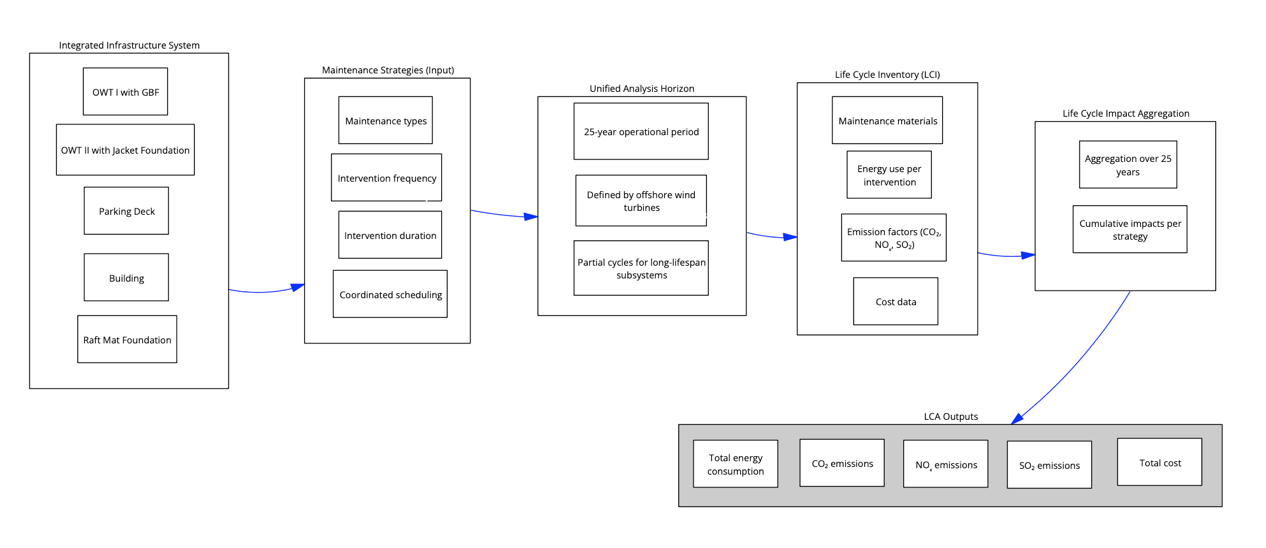
Fig. 1
As illustrated in Figure 1, the system boundary includes material production for maintenance activities, execution of maintenance and repair interventions, associated energy use and emissions (CO2,NOx, SO2), and the resulting economic costs. By applying a consistent temporal and system boundary, the LCA enables a transparent evaluation of trade-offs between maintenance intensity, environmental performance, and cost efficiency at the system level.
Life-Cycle Inventory of Materials
Table 1 presents the Life-Cycle Inventory (LCI), translating maintenance actions into quantifiable material, energy, and emission flows over the defined 25-year operational horizon.
Table. 1
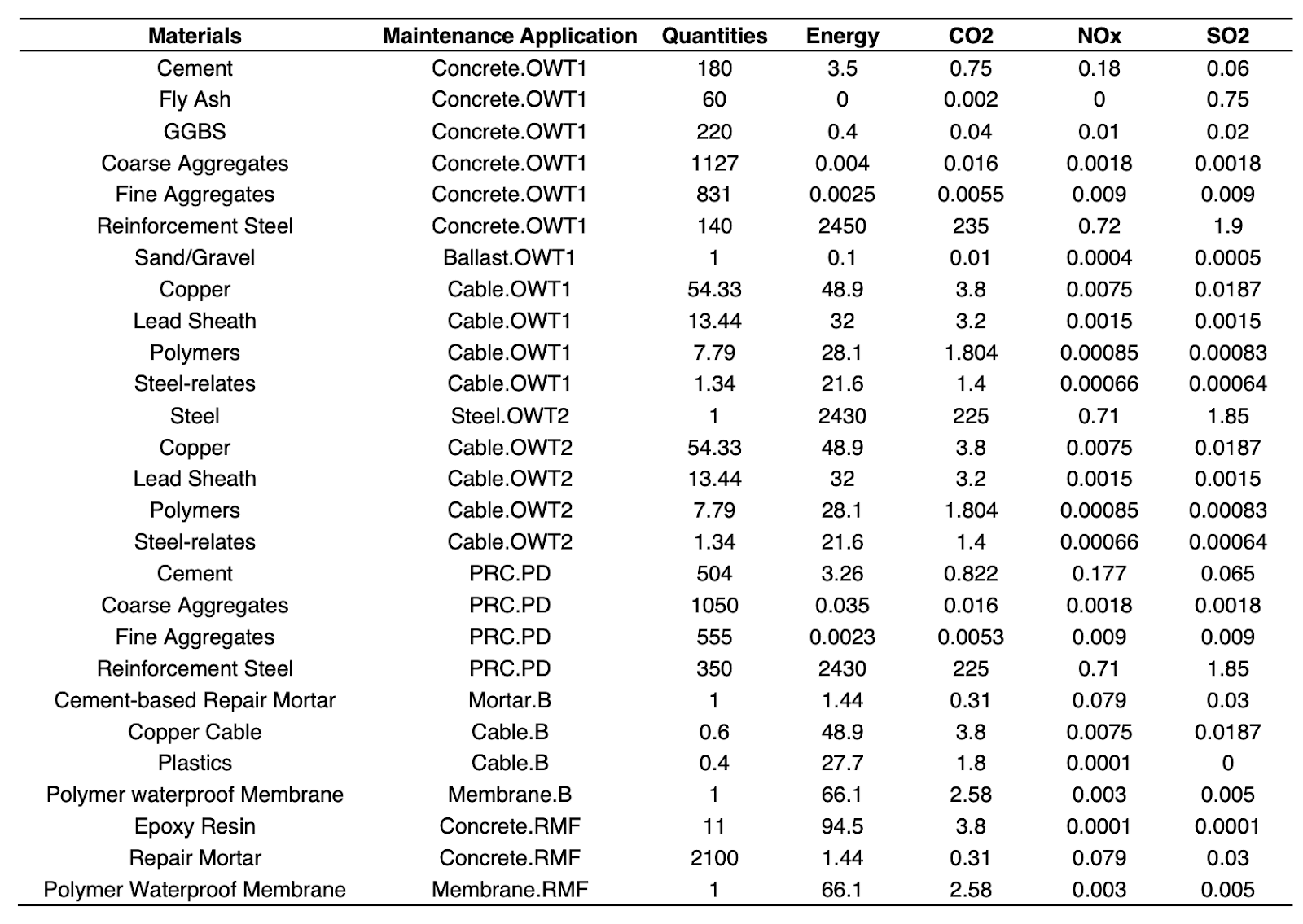
For materials belonging to “concrete”, the listed values represent the quantities required to produce 1 m³ of concrete, the same as other fixed materials. Especially, materials under the “cable” category correspond to the quantities required to manufacture 1 m of cable. For materials such as steel, the “Quantities” value is uniformly set to 1, indicating that all environmental data (energy use and emission factors) are calculated per 1 kg of material produced.
The Maintenance Application column identifies the maintenance application context in which each material is used, rather than distinguishing between repair, renewal, or replacement. As the analysis horizon is defined by the operational lifetime of the offshore wind turbines, no full component replacement is considered.
Materials therefore represent intervention-level inputs associated with localized repairs, surface treatments, and protective systems. For long-lifespan subsystems, only partial maintenance cycles occurring within the 25-year period are included.
Replacement Ratios for Maintenance Activities
Table 2
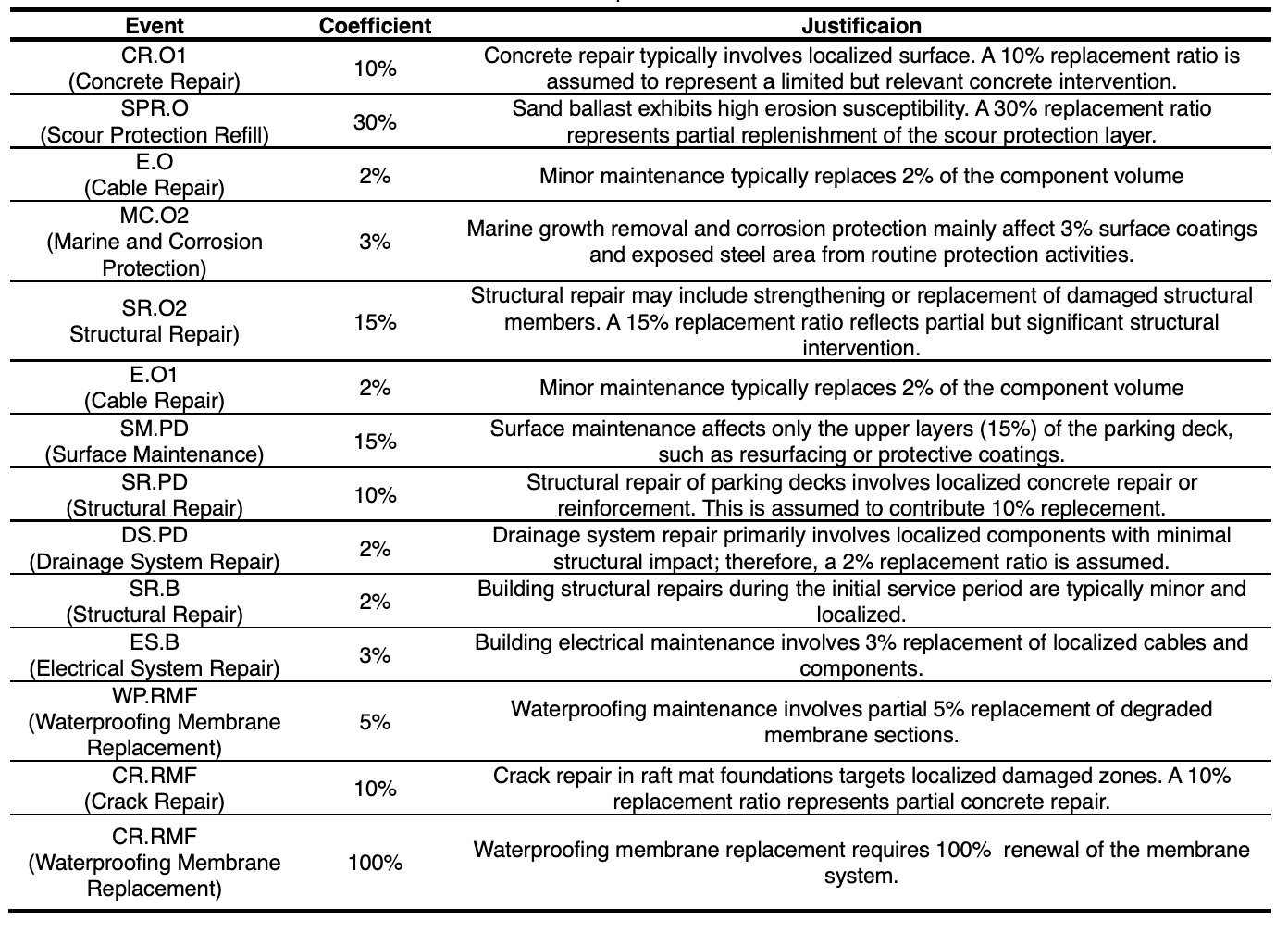
Table 2 summarizes the replacement ratios associated with each maintenance activity.
The coefficients reflect the relative extent to which each intervention affects the overall structural system. By scaling maintenance actions proportionally, these coefficients ensure that life-cycle impacts are realistically represented in the analysis. This approach improves the accuracy of maintenance strategy evaluation and supports a more reliable assessment of long-term performance and cost efficiency.
Life-Cycle Impact Calculation
Using the values defined in the Life-Cycle Inventory of Materials, life-cycle impacts are calculated for each maintenance strategy by aggregating material-specific energy use, and emissions across all maintenance interventions within the 25-year analysis horizon.
For a given strategy, total energy consumption and emissions (CO2,NOx, SO2) are obtained by summing the contributions of all materials involved in the corresponding maintenance actions, weighted by their quantities and intervention frequencies. Material-specific impact factors are applied consistently across all subsystems.
By applying the values defined in the preceding tables, we generated the Life-Cycle Assessment (LCA) results for the three aforementioned maintenance strategies. As illustrated in Figure 2, it is evident that Strategy 2 delivers the best performance in terms of both energy consumption and emissions.
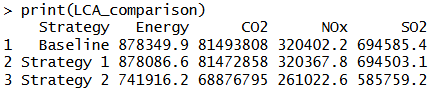
Fig. 2
By defining unit prices for each material and emission category (Table 3), the LCA results are further monetized, allowing maintenance strategies to be evaluated from both environmental and economic perspectives.
Table. 3
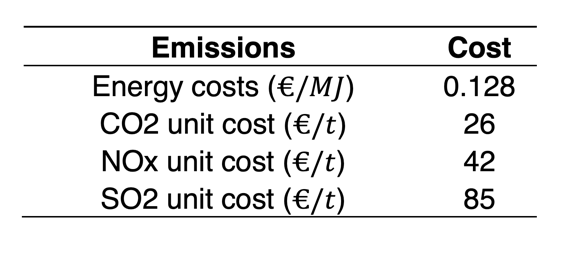
By incorporating these unit costs to monetize emissions, the resulting data in Fig. 3 reflects the combined economic and environmental burden of each strategy, highlighting Strategy 2 as the most cost-effective option across both dimensions.

Fig. 3
Rather than evaluating individual combinations in isolation, the resulting life-cycle impact vectors form the basis for a multi-objective comparison across the full solution space. These aggregated indicators are subsequently used as input for Pareto-based optimization, enabling a systematic assessment of trade-offs between environmental impact, cost, and maintenance performance.
References
ecoinvent. (2025). ecoquery – ecoinvent database (version 3.12). ‘wind power plant construction, 2MW, offshore, fixed parts’.
ecoinvent. (2025). ecoquery – ecoinvent database (version 3.12). ‘wire drawing, copper’. https://ecoquery.ecoinvent.org/3.12/cutoff/dataset/3328/documentation
Bruyn, S., Bijleveld, M., de Graaff, L., Schep, E., Schroten, A., Vergeer, R., & Ahdour, S. (2018). Environmental Prices Handbook: EU28 version. CE Delft.
Anderson, J., & Moncaster, A. (2020). Embodied carbon of concrete in buildings, Part 1: analysis of published EPD. Buildings & Cities, 1(1).
McGrath, T., Nanukuttan, S., Basheer, P. A. M., Long, A., Owens, K., & Doherty, W. (2012, September). Embodied energy and carbon footprinting of concrete production and use. In Proceedings of the 3rd International Conference on the Durability of Concrete Structures, ICDCS (Vol. 2012).
Matthes, W., Vollpracht, A., Villagrán, Y., Kamali-Bernard, S., Hooton, D., Gruyaert, E., … & De Belie, N. (2017). Ground granulated blast-furnace slag. In Properties of Fresh and Hardened Concrete Containing Supplementary Cementitious Materials: State-of-the-Art Report of the RILEM Technical Committee 238-SCM, Working Group 4 (pp. 1-53). Cham: Springer International Publishing.
Anh, L. H., Mihai, F. C., Belousova, A., Kucera, R., Oswald, K. D., Riedel, W., … & Schneider, P. (2023). Life cycle assessment of river sand and aggregates alternatives in concrete. Materials, 16(5), 2064.
European Investment Bank. (2021). Modular Offshore Grid 2 (MOG2): Life cycle analysis (EIB Project No. RA21182). European Investment Bank.
Franklin Associates. (2018). Life cycle inventory of polyethylene resin (HDPE). American Chemistry Council.
Wang, S., Sun, T., & Li, X. (2020). Life cycle assessment of offshore wind power systems with different maintenance strategies. Renewable Energy, 145, 1541–1552.
Wang, S., Zeng, J., & Fan, Z. (2021). Durability analysis of high-performance concrete for marine engineering based on long-term exposure tests. Journal of Civil Engineering, 54(10), 82–89. (Chinese)
Mayall, R. O., McAdam, R. A., Whitehouse, R. J., Burd, H. J., Byrne, B. W., Heald, S. G., … & Slater, P. L. (2020). Flume tank testing of offshore wind turbine dynamics with foundation scour and scour protection. Journal of Waterway, Port, Coastal, and Ocean Engineering, 146(5), 04020033.
Nuss, P., & Eckelman, M. J. (2014). Life cycle assessment of metals: a scientific synthesis. PloS one, 9(7), e101298. https://doi.org/10.1371/journal.pone.0101298
PlasticsEurope, & European Council of Vinyl Manufacturers (ECVM). (2023). Vinyl chloride (VCM) and polyvinyl chloride (PVC): Eco-profiles and environmental product declarations of the European plastics manufacturers. https://pvc.org/wp-content/uploads/2023/06/230628_Eco-profile-PVC_june23.pdf
Limak Doğu Anadolu Çimento A.Ş. (2025). Environmental product declaration (EPD): CEM PLUS+ (CEM II/A-LL 42.5R). International EPD System, EPD-IES-0025715. https://www.environdec.com/library/epd25715
Francart, N., Widström, T., & Malmqvist, T. (2021). Influence of methodological choices on maintenance and replacement in building LCA. The International Journal of Life Cycle Assessment, 26(11), 2109-2126.
Franklin Associates. (2018). Life cycle inventory of epoxy resin systems. American Chemistry Council.
McGrath, T., Nanukuttan, S., Basheer, P. A. M., Long, A., Owens, K., & Doherty, W. (2012, September). Embodied energy and carbon footprinting of concrete production and use. In Proceedings of the 3rd International Conference on the Durability of Concrete Structures (ICDCS 2012)
Franklin Associates. (2018). Life cycle inventory of polyethylene resin (HDPE). American Chemistry Council.
Almusallam, A. A., Khan, F. M., Dulaijan, S. U., & Al-Amoudi, O. S. B. (2003). Effectiveness of surface coatings in improving concrete durability. Cement and Concrete Composites, 25(4–5), 473–481.
ACI Committee 224. (2007). ACI 224.1R-07: Causes, evaluation, and repair of cracks in concrete structures. American Concrete Institute.
Perelli, F., Baroni, L., & Di Pietro, G. (2019). Durability and service life of waterproofing systems in concrete foundations and underground structures. Construction and Building Materials, 199, 343–354.ISO. (2017). ISO 15686-1: Buildings and constructed assets—Service life planning—Part 1: General principles. International Organization for Standardization.
Home | Introduction | Integrated System | Maintenance Strategies | Life Cycle Analysis | Multi-Objective Optimization | Conclusion and Limitations