Road infrastructure is a fundamental component of modern societies, providing the basis for mobility, economic activity, and social connectivity. At the same time, the construction, maintenance, and rehabilitation of roads are associated with substantial material and energy consumption, leading to significant environmental impacts over their entire life cycle.
In this context, the assessment of different pavement structures from an environmental perspective is particularly important. Even small differences in material selection, structural design or maintenance frequency can result in considerable variations in energy demand and emissions. Therefore, the systematic comparison of alternative road construction options is essential for promoting more sustainable infrastructure development and supporting informed decision-making in road engineering.
Three different Road Options
The comparison refers to 1 m² of a road section of load class BK 1,8 according to the RStO1. Three structural variants of the pavement are assessed, which differ in the materials used and the layer configurations (Figure 1). The variants include an asphalt construction (Option 1), a combination of an asphalt base layer and an upper reinforced concrete deck (Option 2), and a structure with a gravel base layer and concrete pavers (Option 3).

Figure 1 : Sketch of the three Options
Life-Cycle Inventory and Analysis
The life-cycle assessment shows that the environmental impacts of the pavement options are mainly determined by the materials used (Figure 2). Option 2 has the highest impacts due to the reinforced concrete slab and asphalt base course, particularly in terms of CO2 equivalents and primary energy demand. Option 1 shows high primary energy consumption and SOX emissions as a result of its bitumen-based asphalt layers and their frequent renewal. Option 3 performs best overall, as it primarily uses mineral materials with low specific environmental impacts. Despite more frequent interventions, its total environmental burdens remain low, making mineral-based constructions the most environmentally favorable option.
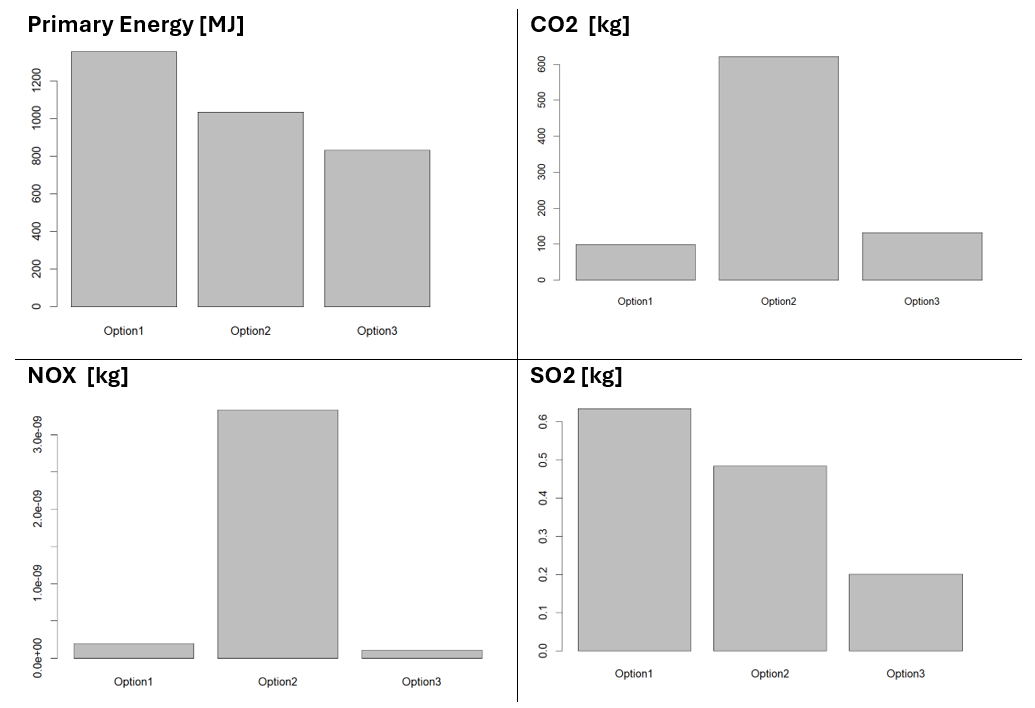
Figure 2 : LCA Results
MCDM – AHP
The Analytic Hierarchy Process (AHP) is applied to systematically evaluate the three pavement design options based on four environmental criteria (primary energy, CO2, NOX and SO2). The criteria are weighted according to their relative importance for the environmental assessment.
The results of the AHP ranking (Figure 3) show a clear preference for Option 2 with 59.2 %, followed by Option 1 with 22.8 % and Option 3 with 18 %. Thus, the results of the AHP analysis indicate that Option 2 is rated as the most sustainable solution despite its consistently higher environmental impacts, whereas Option 3 now is classified as the least favorable alternative.
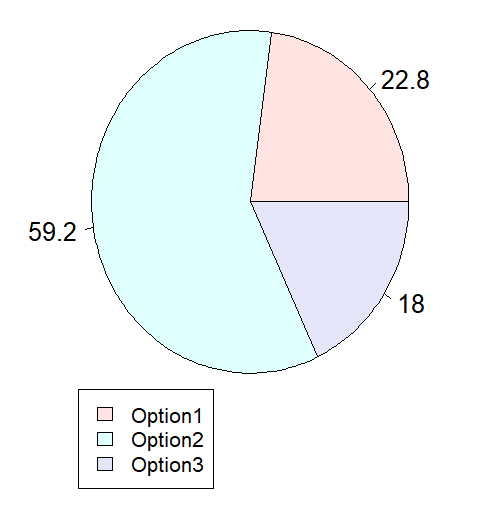
Figure 3 : Ranking of the Design Options using AHP
1Since the original figure was not available to me, I referred to the illustration of the BK 1,8 pavement structure from the lecture materials of module Grundlagen des Straßenwesens (WiSe 22/23), which is based on the RStO. Only the tables for asphalt and paving surfaces were available, therefore I assumed the same layer thickness for the concrete surface variant as for the asphalt surface variant. The possibility of an asphalt base course beneath the reinforced concrete arises from[1, p.16/17]
Originally, the NOX data were reported as CFC-11 eq. and the SO2 data as NMVOC eq.. These indicators were renamed to NOX and SO2, respectively, to ensure consistency and comparability with the other systems considered in this study.
References
[1] S. Wiedemann, ‘Untersuchungen zur Bauweise Asphaltzwischenschicht unter Betonfahrbahnen’, TU München, München, 2021. Accessed: Nov. 09, 2025. [Online]. Available: https://mediatum.ub.tum.de/doc/1613503/1613503.pdf
[2] ‘Prozess-Datensatz: Asphalttragschicht’, ÖKOBAUDAT. Accessed: Nov. 09, 2025. [Online]. Available: https://oekobaudat.de/OEKOBAU.DAT/datasetdetail/process.xhtml?uuid=9795c91c-0918 46fa-8a51-47deb180c271&version=20.24.070&stock=OBD_2024_I〈=de
[3] ‘Prozess-Datensatz: Schotter 16/32’, ÖKOBAUDAT. Accessed: Nov. 09, 2025. [Online]. Available: https://oekobaudat.de/OEKOBAU.DAT/datasetdetail/process.xhtml?uuid=f4461491-586a 4770-9a04-716565e58c24&version=20.24.070&stock=OBD_2024_I〈=de
[4] ‘Prozess-Datensatz: Gussasphalt’, ÖKOBAUDAT. Accessed: Nov. 09, 2025. [Online]. Available: https://oekobaudat.de/OEKOBAU.DAT/datasetdetail/process.xhtml?uuid=b29d88ed-8621 4ece-9e2f-78af05cb3f0f&version=20.24.070&stock=OBD_2024_I〈=de
[5] ‘Prozess-Datensatz: Beton C30/37 XC4 XF1 XA1 F3 16 M Ecopact R Beton, Rezept Nummer DA5234R-DSFR, Transportbetonwerk Troisdorf, Germany’, ÖKOBAUDAT. Accessed: Nov. 09, 2025. [Online]. Available: https://oekobaudat.de/OEKOBAU.DAT/datasetdetail/process.xhtml?uuid=bebc6b70-ac71 4585-a715-9de0250d5bc6&version=00.01.000&stock=OBD_2024_I〈=de
[6] A. Grünewald and M. Peck, ‘Fahrbahndeckenbeton für Straßen’. Accessed: Nov. 09, 2029. [Online]. Available: https://www.vdz online.de/fileadmin/wissensportal/publikationen/basiswissen/zement merkblaetter/S1.pdf
[7] ‘Prozess-Datensatz: Bewehrungsstahl’, ÖKOBAUDAT. Accessed: Nov. 09, 2025. [Online]. Available: https://oekobaudat.de/OEKOBAU.DAT/datasetdetail/process.xhtml?uuid=f6861618-5a92 4c3a-94ba-9f7329b29662&version=20.24.070&stock=OBD_2024_I〈=de [10]
[8] ‘Prozess-Datensatz: Bewehrungs- und Befestigungssystem – solidian GmbH – solidian ANTICRACK’, ÖKOBAUDAT. Accessed: Nov. 09, 2025. [Online]. Available: https://oekobaudat.de/OEKOBAU.DAT/datasetdetail/process.xhtml?uuid=18bbbde1-185f 490b-8d53-b615c50e5460&version=00.00.010&stock=OBD_2024_I〈=de [11]
[9] ‘Prozess-Datensatz: A2-Betonpflaster- Standardstein grau mit Vorsatz’, ÖKOBAUDAT. Accessed: Nov. 09, 2025. [Online]. Available: https://oekobaudat.de/OEKOBAU.DAT/datasetdetail/process.xhtml?uuid=0fdca580-3027 493d-a3c7-815758bac55d&version=00.03.000&stock=OBD_2024_I〈=de [12]
[10] ‘Prozess-Datensatz: Lambada Forte Betonpflasterstein’, ÖKOBAUDAT. Accessed: Nov. 09, 2025. [Online]. Available: https://oekobaudat.de/OEKOBAU.DAT/datasetdetail/process.xhtml?uuid=6b2d1a5a-f12d 48cc-9b35-622225ceb307&version=00.02.000&stock=OBD_2024_I〈=de [13]
[11] Bundesanstalt für Straßenwesen, Ed., Dec. 2017. Accessed: Nov. 09, 2025. [Online]. Available: https://www.bast.de/DE/Publikationen/Regelwerke/Ingenieurbau/Entwurf/Kap Kappenausbildung-Entwurf.pdf?__blob=publicationFile&v=7
[12] T. L. Saaty and L. G. Vargas, Models, Methods, Concepts & Applications of the Analytic Hierarchy Process, 2. ed. in International series in operations research & management science, no. 175. New York: Springer, 2012.
Home | Roads | Sewer Pipeline | RCC Tank | Warehouse | Residential Home Foundation