Goal and Scope
The objective of this LCA is the holistic evaluation of an integrated infrastructure system, with particular emphasis on environmental impacts, life-cycle costs and the role of coordinated maintenance strategies. The analysis aims to make the ecological and economic consequences of decision-making transparent not at the level of individual assets, but within the context of a functionally and spatially interconnected overall system.
The scope of the study comprises the defined subsystems of an integrated infrastructure system consisting of a pipeline network, road infrastructure, an RCC tank, a warehouse building and a residential building. These subsystems are not assessed in isolation, but are modelled as interlinked components of a common operational system, including their physical and functional interfaces. The temporal scope of the assessment corresponds to a service life of 25 years. The system boundary of the LCA includes all relevant life-cycle phases, as illustrated in Figure 1:
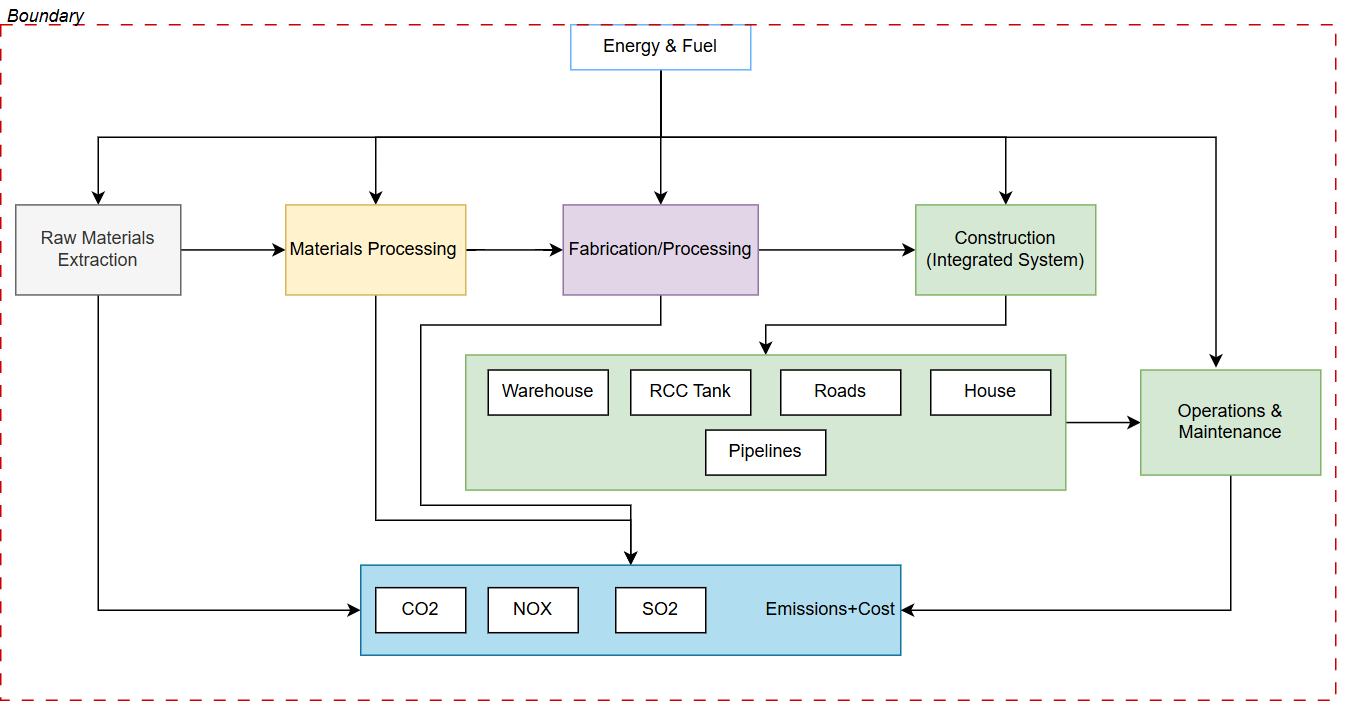
Figure1 : LCA Boundary
Energy use and emissions are accounted for across all life-cycle phases. The assessment considers both environmental impacts, specifically CO2, NOX and SO2 emissions and life-cycle-related costs as outcome indicators. Emissions and costs are not only attributed to individual components, but are aggregated at the system level in order to capture interactions and cumulative effects across the integrated infrastructure system.
Life-Cycle Inventory (LCI) of the materials
The LCI forms the quantitative basis of the LCA and includes all materials used as well as the associated energy consumption and emission factors. The materials considered, their corresponding densities and the specific indicators for energy demand and emissions are summarized in Table 1. For each material, the material density, the specific energy requirement and emission factors for CO2, NOX and SO2 are provided. These parameters constitute the basis for the calculation of life-cycle-wide environmental impacts in the subsequent analysis steps.
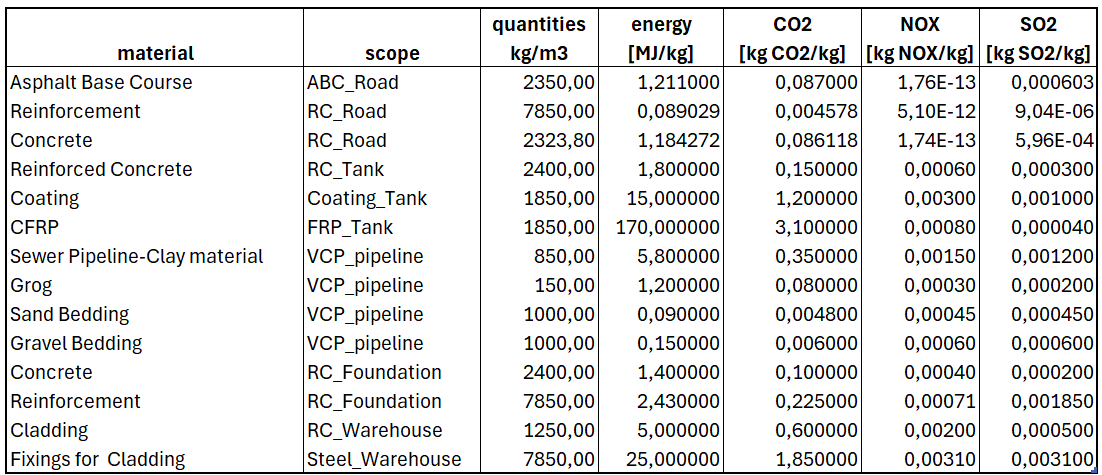
Table 1 : Life-Cycle Inventory of the materials used with energy and emission factors
The energy demand and emission factors are calculated based on geometric modelling of the individual system components implemented in the R code. The adopted dimensions and characteristic parameters of all considered subsystems are presented in Table 2. These parameters serve as input variables for the calculation of volumes, material masses and subsequently the environmental impacts.
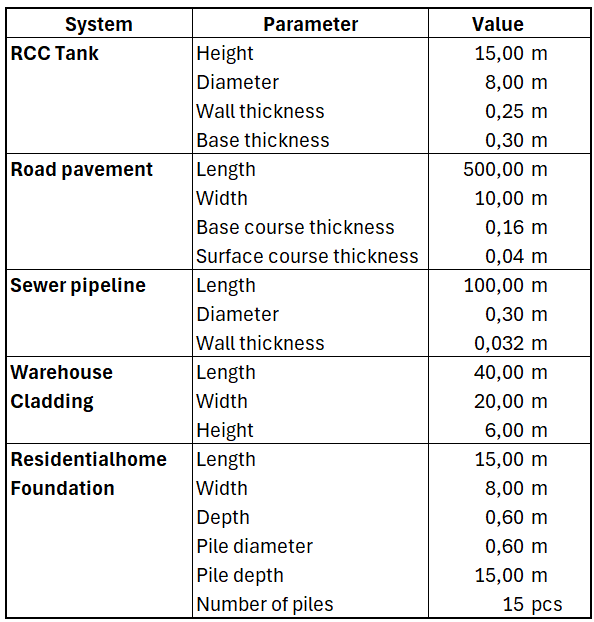
Table2 : Geometric parameters and dimensions of the considered systems
Interventions
The intervention factors presented in Table 3 indicate the share of the original material quantity of a system that is additionally considered for a specific maintenance activity. Low factors represent minor interventions such as inspections or small repairs, whereas higher factors correspond to more extensive measures such as renewals or structural repairs. The factors are multiplied by the number of corresponding interventions over the 25-year service life and applied to the geometrically calculated material quantities. The resulting cumulative material quantities are subsequently used to calculate energy consumption as well as CO2, NOX and SO2 emissions in the LCA.
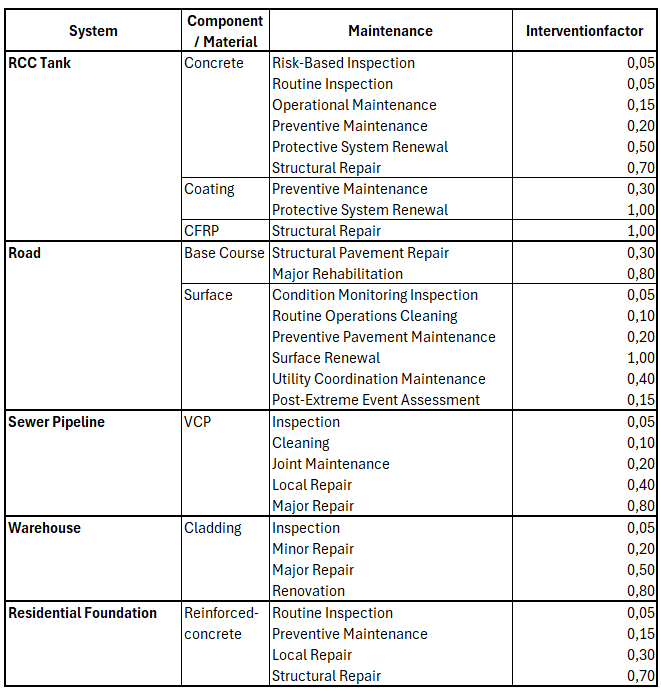
Table 3 : Intervention factors for maintenance activities by system and component
Analysis and Results of the LCA
Figure 2 presents the aggregated environmental impacts and costs of the integrated system over the entire life cycle. The cumulative energy consumption amounts to approximately 1,18 billion MJ, reflecting both the initial construction and the material-related demands resulting from maintenance activities. The calculated CO2 emissions are approximately 23,3 million kg, representing the dominant environmental impact. In comparison, NOX emissions of about 11.600 kg and SO2 emissions of approximately 7.100 kg are significantly lower, yet remain relevant indicators of air-pollutant-related environmental impacts of the system.
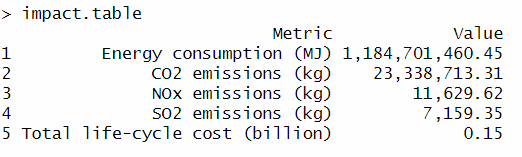
Figure 2 : LCA Results
In addition to the environmental indicators, monetary effects were also considered. Based on the unit costs for energy and emissions provided in Table 4, the total life-cycle cost amounts to approximately 0,15 billion euros. This value highlights that environmental impacts and economic effects are closely interrelated and need to be evaluated jointly.
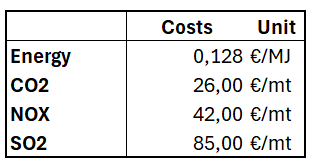
Table 4: Costs [1],[2],[3]
Overall, the results indicate that the environmental and cost impacts of the integrated system are largely driven by material-intensive components and recurring maintenance activities. The integrated assessment makes it possible to capture cumulative effects across all subsystems and thus provides a robust basis for comparing alternative maintenance and planning strategies.
References
[1] Eurostat, “Electricity price statistics,” European Commission, 2023.
[2] European Commission, “EU Emissions Trading System (EU ETS),” Climate Action – European Commission, 2019.
[3] European Commission, Handbook on the External Costs of Transport, Directorate-General for Mobility and Transport, 2019.
The references for all the values an information of the subsystems are on the websites from the individual systems.
Home | Introduction | Integration Context | Maintenance Strategies | Life Cycle Analysis | Multi-Objective Optimization