For Maintenance Strategy 3, maintenance intervals were defined in accordance with values commonly reported in the literature and established engineering practice. All intervention ranges (table 3.a) were selected to remain within acceptable durability and performance limits for each subsystem, ensuring that the integration logic does not introduce technically unrealistic maintenance assumptions. The maintenance ranges in this strategy serve as flexible boundaries within which maintenance actions may be temporally adjusted to improve material logistics coordination. The timing of individual interventions may shift within the specified ranges, while the nature and technical scope of the maintenance actions remain unchanged.
| Subsystem | Surface Repair | Major Repair/ Rehabitation | Replacement |
| Gravity Retaining Wall | 15-25 | 45-55 | 35-45 |
| ETICS | 20-60 | – | 55-65 |
| Cantilever Retaining Wall | 15-30 | 20-60 | 45-55 |
| Hardwood Flooring | 20-40 | – | 55-65 |
| Concrete Beam with Hollow Floor Slab | – | 20-25 | – |
A key input required for the system-level analysis is the time impact associated with each maintenance action. For this reason, representative activity durations were assigned to each intervention type. These values (in table 3.b) describe the length of time during which system functionality is partially affected due to maintenance execution. They provide a standardized way to translate maintenance actions into measurable system interruption effects. Importantly, while the timing of actions may vary within the defined limits, the total maintenance demand of each subsystem remains unchanged. This makes it possible to isolate the influence of logistics-based coordination on cumulative interruption levels and life cycle performance, without confounding the analysis with changes in maintenance intensity or technical scope.
| Subsystem | Surface Repair | Major Repair/ Rehabitation | Replacement |
| Gravity Retaining Wall | 2 | 10 | 5 |
| ETICS | 3 | – | 5 |
| Cantilever Retaining Wall | 3 | 10 | 20 |
| Hardwood Flooring | 2 | 5 | 25 |
| Concrete Beam with Hollow Floor Slab | 8 | 25 | – |
Maintenance planning is carried out for each subsystem separately, defining intervention intervals over a 100-year service of life. In an integrated setting, maintenance actions interact through time. Activities that are acceptable when planned independently may overlap once combined, creating periods with increased maintenance intensity and higher service disruption. This effect becomes more pronounced as the number of subsystems increases, particularly when several interventions rely on similar resources or access conditions.
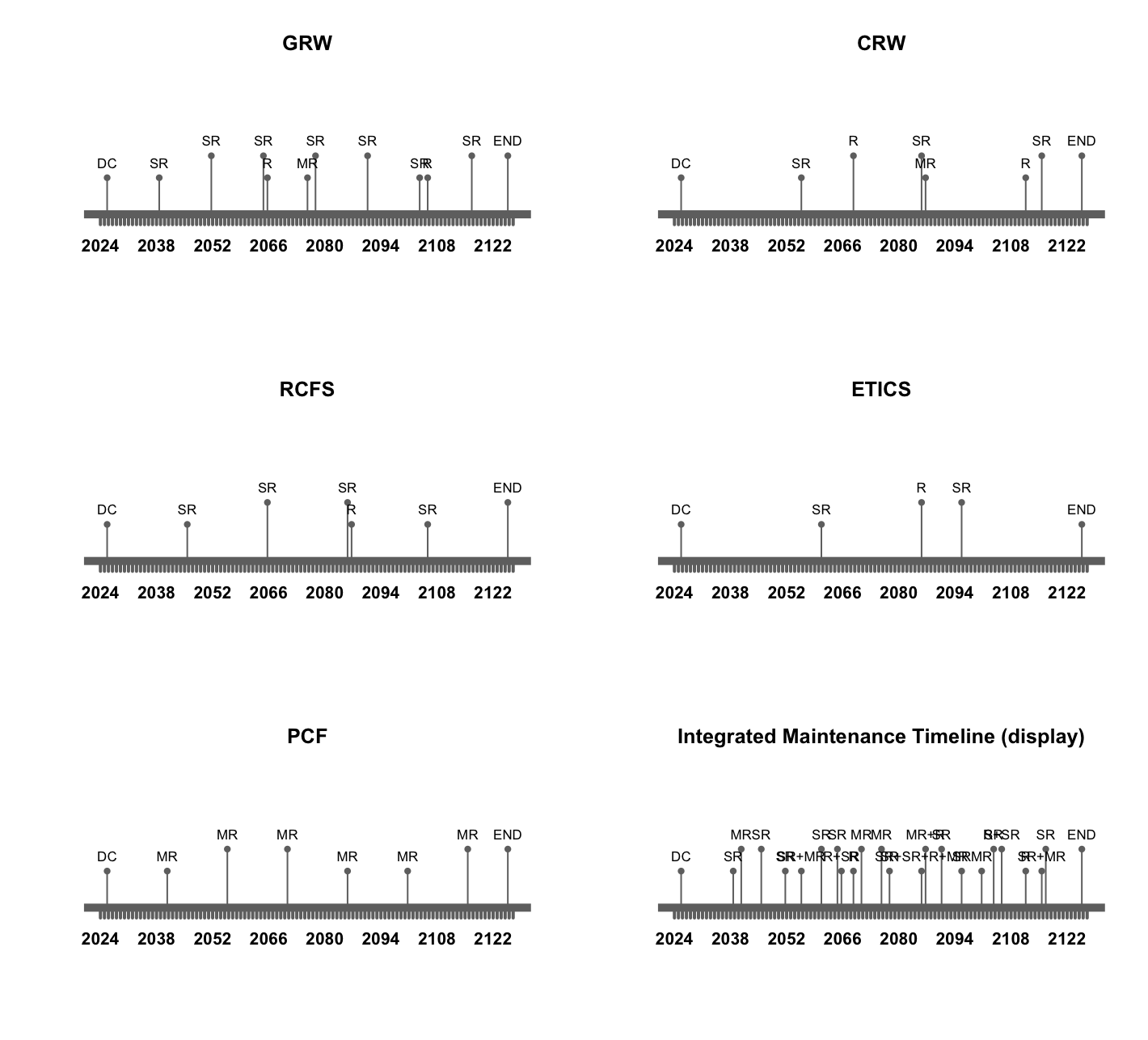
Figure 3.a illustrates the individual timelines of (GRW, CRW, RCFS, ETICS, and PCF), and maintenance actions are placed according to their allowed maintenance ranges and typical frequencies, without any coordination across subsystems. The integrated timeline highlights how these independently planned interventions accumulate when viewed at the system level. Several maintenance actions from different subsystems occur within similar time periods, leading to visible clustering of events. This clustering is not the result of optimization but emerges naturally from overlapping maintenance ranges. In Strategy 3, this type of overlap is particularly relevant, as maintenance actions requiring material delivery can be intentionally aligned to reduce repeated transport and logistics-related disruption.
Home | System Definition | Scenario 1 | Scenario 2 | Scenario 3 | Scenario 4 | Discussion | Appendix