Rainfall-Triggered Retaining Wall Prioritization Strategy
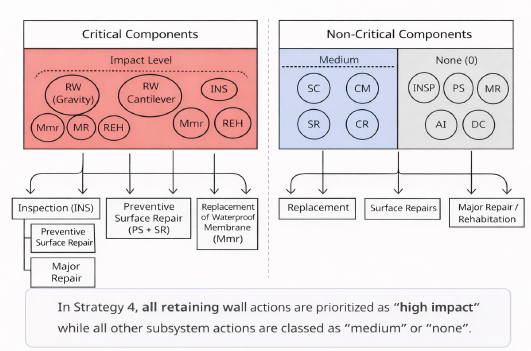
The strategy is based on the recognition that certain subsystems play a decisive role in maintaining the global stability of the overall system. In particular, the retaining walls act as foundational structural elements, and any degradation or failure in their performance would compromise the functionality and safety of all dependent systems [17,18].
In the non-integrated maintenance configuration, all subsystems follow their individual maintenance schedules independently. Maintenance actions are executed according to nominal service intervals, without explicit consideration of the relative structural importance of different components within the system.
Strategy 4 explicitly preserves the original maintenance schedules of the two retaining walls including all inspection, repair, and rehabilitation activities associated with these components remain unchanged in both timing and sequence. This ensures that no integration-driven adjustments affect the subsystems responsible for providing structural stability to the entire system.
For all other subsystems, limited flexibility in maintenance timing is introduced. Maintenance intervals for non-structural components may be shifted within realistic and technically acceptable bounds to improve overall system integration. These adjustments are made without altering the type or intensity of maintenance actions, and without affecting the performance requirements of the individual subsystems.
By fixing the maintenance schedules of the retaining walls and allowing controlled adjustments only for non-critical systems, Strategy 4 embeds structural safety as a governing rule within the integrated maintenance framework. This approach ensures that coordination and optimization efforts do not propagate unintended risks to the structural backbone of the system.
Rather than optimizing coordination through access, workforce organization, or material logistics, Strategy 4 treats structural safety as a non-negotiable boundary condition for integration. The maintenance schedules of the two retaining walls act as fixed reference elements within the system, reflecting their role in maintaining global stability. All other subsystems are integrated around these fixed schedules. Together with the earlier strategies, it completes the comparison by showing how different integration principles of efficiency-driven versus safety-constrained can lead to distinct maintenance outcomes and life-cycle trade-offs at the system level.
Home | System Definition | Scenario 1 | Scenario 2 | Scenario 3 | Scenario 4 | Discussion | Appendix