Introduction
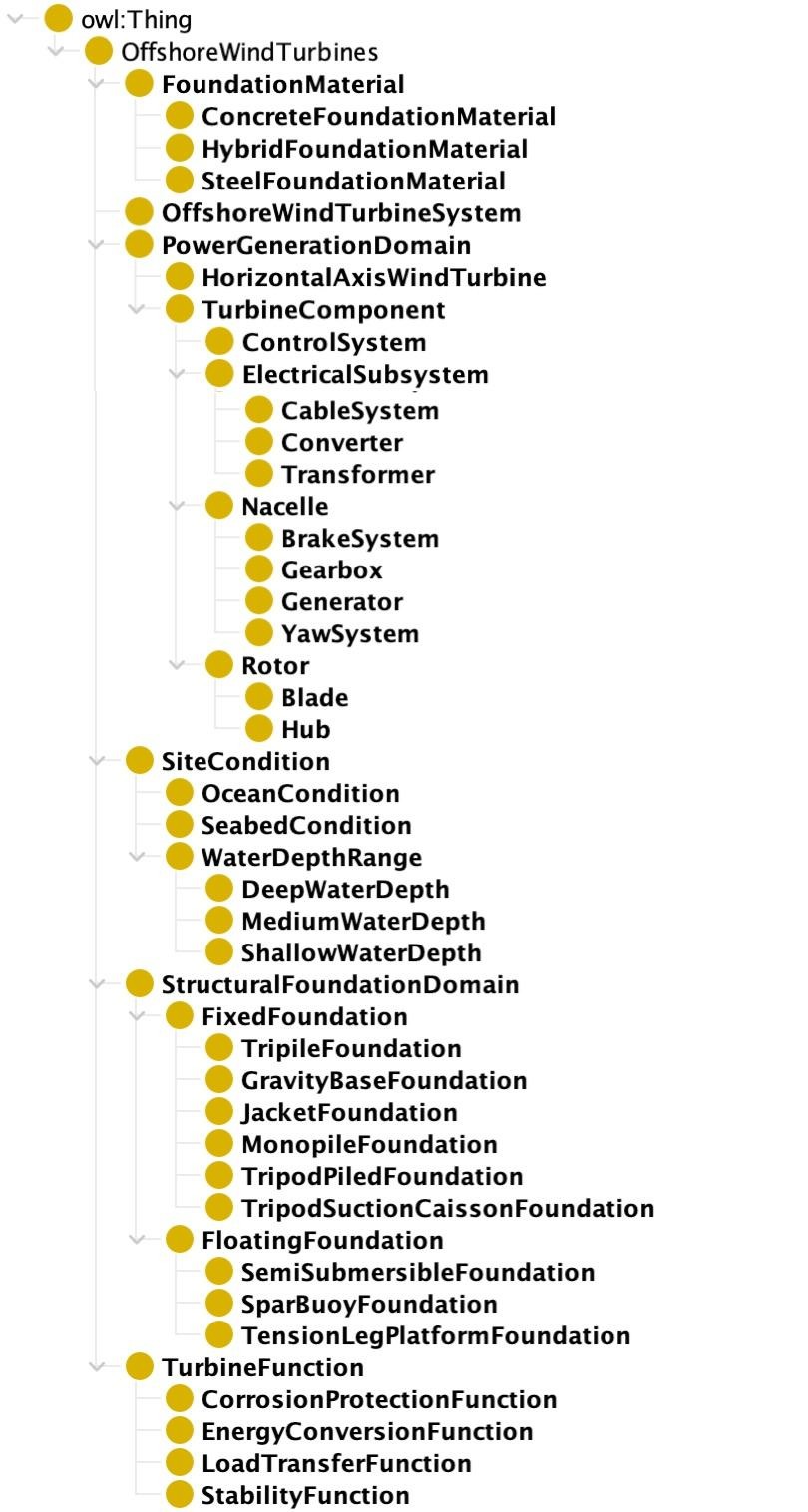
Offshore wind turbine foundations are critical structural systems that ensure stability, load transfer, and long-term performance under marine environmental conditions. This ontology models offshore wind turbine systems by organizing foundation types, materials, site conditions, and functional roles into a structured and machine-interpretable framework.
The purpose of the ontology is to support preliminary foundation selection and engineering analysis by clarifying how water depth, environmental loads, materials, and functional requirements influence foundation design. It is intended for use in early-stage offshore wind engineering, digital modeling, and knowledge organization.
Features & Relationships
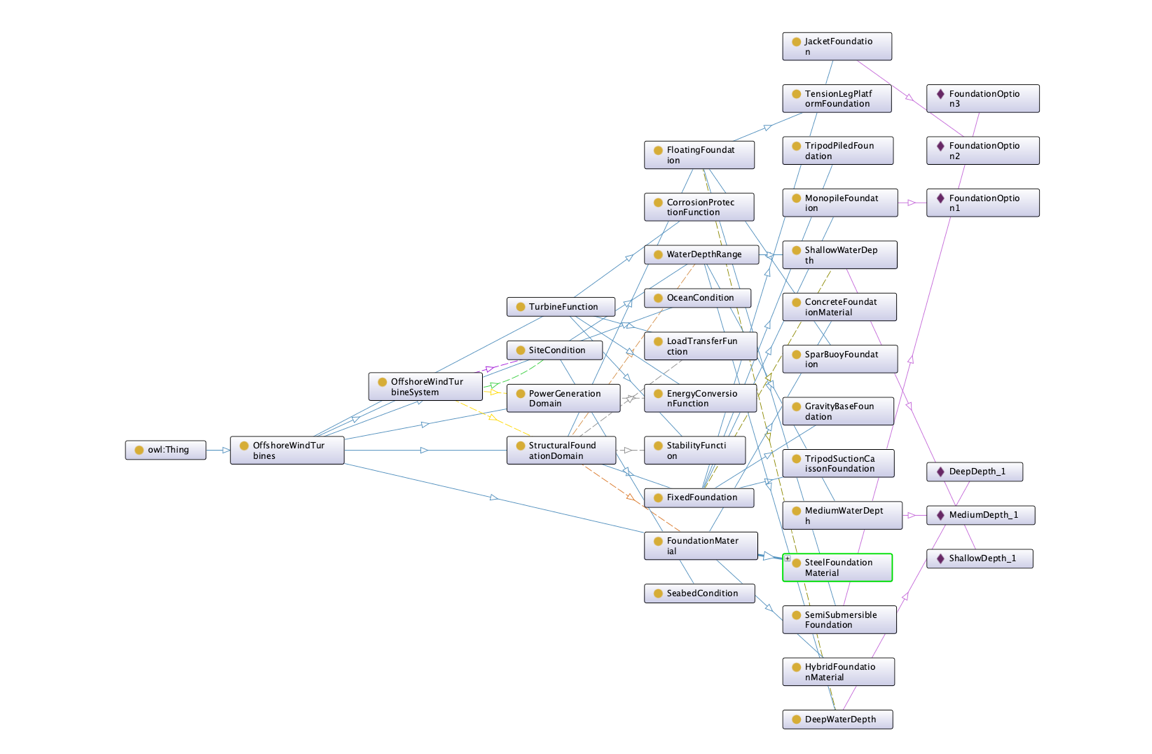
Water depth influences foundation type selection. (Shallow and medium depths support fixed foundations; deep water requires floating foundations.)
Site conditions constrain structural design
(Seabed conditions and environmental loads affect foundation stability and configuration.)
Materials are assigned based on structural and durability requirements
(Steel, concrete, or hybrid materials are selected according to marine exposure and load demands.)
Foundation components enable load transfer and stability
(Piles, jackets, and floating structures transfer environmental loads to the seabed or mooring systems.)
Functional roles define system behavior
(Foundations provide stability and load transfer within the overall turbine system.)
Engineering Examples
1. Depth-based Foundation Classification
A foundation instance assigned a shallow water depth is automatically classified as a fixed foundation, while a deep-water instance is inferred as a floating foundation. This supports automated foundation selection in early design stages.
2. Material-oriented Design Comparison
By assigning material properties, engineers can compare steel, concrete, and hybrid foundation solutions in terms of durability and structural performance.
3. Functional Analysis of Foundation Systems
Functional constraints clarify how different foundation types contribute to stability and load transfer, supporting system-level performance evaluation.
Conclusion
This ontology provides a concise and structured representation of offshore wind turbine foundations and their relationships to site conditions, materials, and system functions. Logical classification confirms its internal consistency and engineering relevance. The model can be extended to include installation or maintenance aspects in future applications.
References
1. Bhattacharya, S. author. (2019). Design of foundations for offshore wind turbines (First edition). Wiley.
2. Jha, A. R. (2011). Wind turbine technology. CRC Press, Taylor & Francis Group. http://search.ebscohost.com/login.aspx?direct=true&db=nlebk&AN=338615
3. Krötzsch, M., Simancik, F., & Horrocks, I. (2013). A Description Logic Primer (No. arXiv:1201.4089). arXiv. https://doi.org/10.48550/arXiv.1201.4089
4. Noy, N. F., & McGuinness, D. L. (2001). Ontology Development 101: A Guide to Creating Your First Ontology.