What is the purpose?
The purpose of this combined ontology is to formally represent an integrated island energy–tourism system by capturing the relationships among offshore wind energy generation, energy management, spatial configuration, and tourism facilities. It provides a unified semantic framework that reduces disciplinary misalignment in the interpretation of design parameters and performance metrics. By aligning the ontology with the parametric and geometric models, it ensures a shared understanding of the system’s design challenges, critical parameters, and performance objectives, thereby supporting informed decision-making and optimization in complex system environments.
What is the scope?
The scope of the ontology is limited to the operational phase of an islanded system, consisting of a single OWT (Tower and Foundation), an energy management Tiny House, a multi-storey Hotel, a Restaurant, and the connecting cable infrastructure (the added one). The ontology focuses on system composition, spatial relationships, energy consumption, and visitor accommodation parameters. It does not address detailed structural analysis, construction processes, or time-dependent simulations.
What are the intended users?
The intended users of this ontology include:
Island operators, who evaluate how design decisions constrain visitor capacity and operational reliability.
Infrastructure engineers, who analyze the coupling between energy supply–demand dynamics and spatial configuration.
Environmental planners, who use the model to define ecological thresholds and guide development intensity.
What is the intended use?
The ontology is intended to serve as a conceptual backbone for integrated system design, enabling:
- A consistent definition of the shared design challenge, design parameters, and HPC.
- Explicit linkage between system components (energy infrastructure, buildings, and cables) and performance evaluation.
- Structured support for parametric modeling, design comparison, and trade-off analysis in islanded renewable energy systems.
Ontology Integration Approach
Class Hierarchy
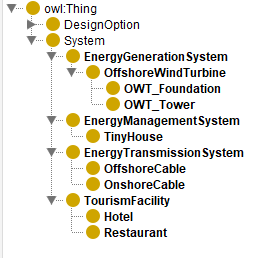
Fig:1
The ontology is structured around a central System superclass, which is decomposed into four primary functional subsystems, as illustrated in Fig. 1, ensuring an explicit representation of both energy dependencies and spatial relationships within the integrated model. These subsystem include: EnergyGenerationSystem, responsible for energy production; EnergyManagementSystem, functioning as the central hub for energy control and distribution; TourismFacility, representing energy-consuming buildings; EnergyTransmissionSystem, introduced as a critical component to model the cable network that physically and functionally connects the other subsystems. Each primary class is further refined into specific subclasses—such as Hotel, Restaurant, and OffshoreWindTurbine—which inherit global properties from their parent classes. This hierarchical inheritance ensures semantic consistency and scalability when extending parameters or incorporating additional system components.
In addition, the ontology defines an independent DesignOption class to represent alternative system configurations. Unlike the infrastructure classes, DesignOption does not correspond to a physical entity on the island but operates at a conceptual level to support the comparison and evaluation of competing design strategies. This enables the ontology to move beyond static system representation toward decision-support functionality.
Object Properties
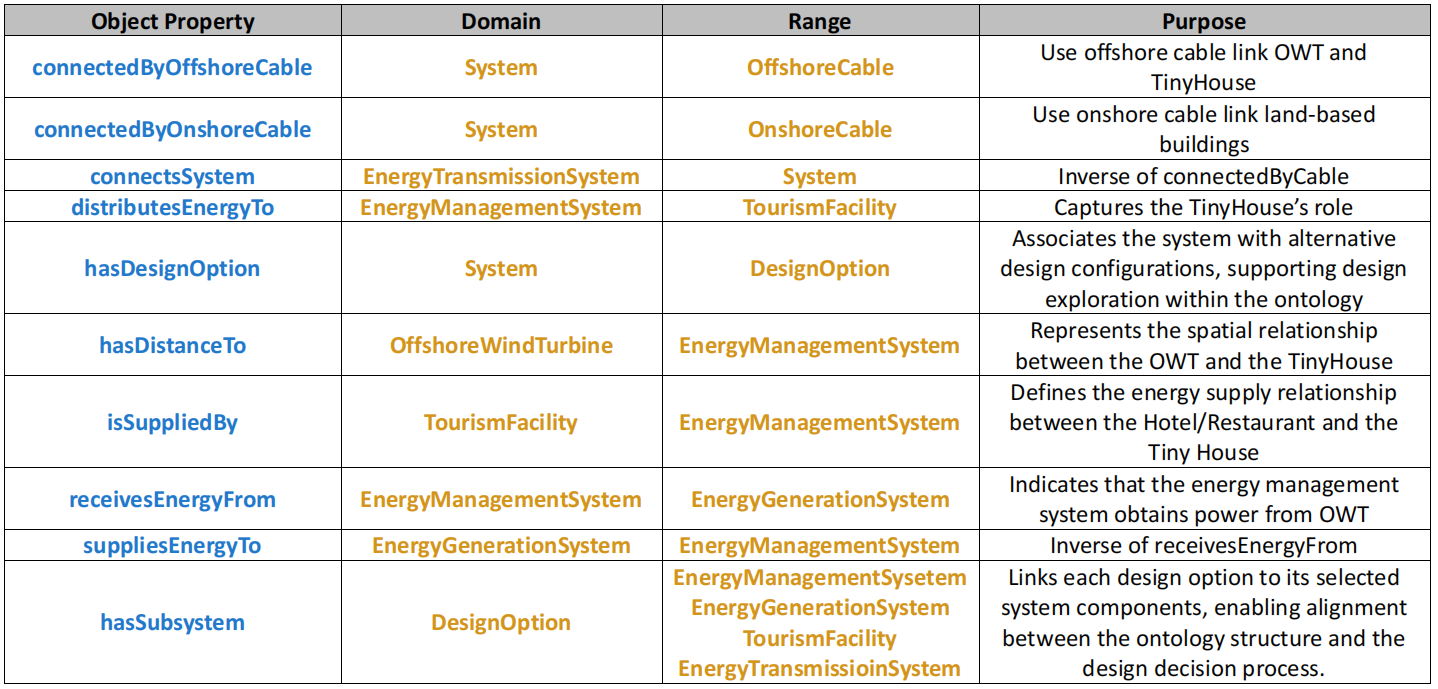
To build a reasoning-enabled integrated system, the ontology defines a set of semantic Object Properties to capture the structural and functional dependencies among the subsystems. These relationships not only describe the pathways of energy flow but also articulate the logical connections between spatial constraints and design decisions, allowing the system to be interpreted and analyzed within a unified semantic framework. The primary relationships are illustrated in Fig. 2, with their formal definitions provided in Table 1.
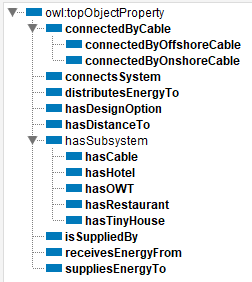
Fig: 2
Table 1
Data Property & Instance Creation
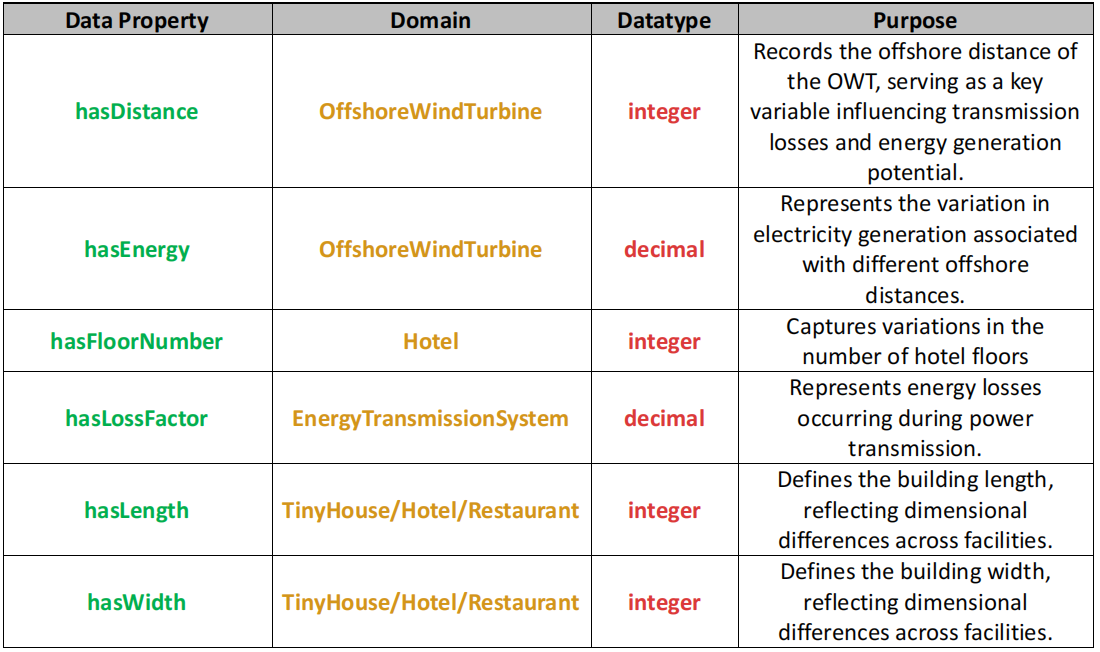
To enhance the computational capability and analytical power of the ontology, a set of Data Properties is introduced to quantify the key parameters that influence the HPC, as summarized in Table 2. These parameters translate abstract system relationships into measurable variables, enabling the ontology not only to represent structural semantics but also to support performance evaluation.
Table 2
Based on that, the ontology further constructs representative design scenarios through Instance creation, enabling the validation of the model’s expressive capacity and reasoning potential under different parameter configurations. The specific instances are presented in Table 3 and Fig. 3.
Table 3
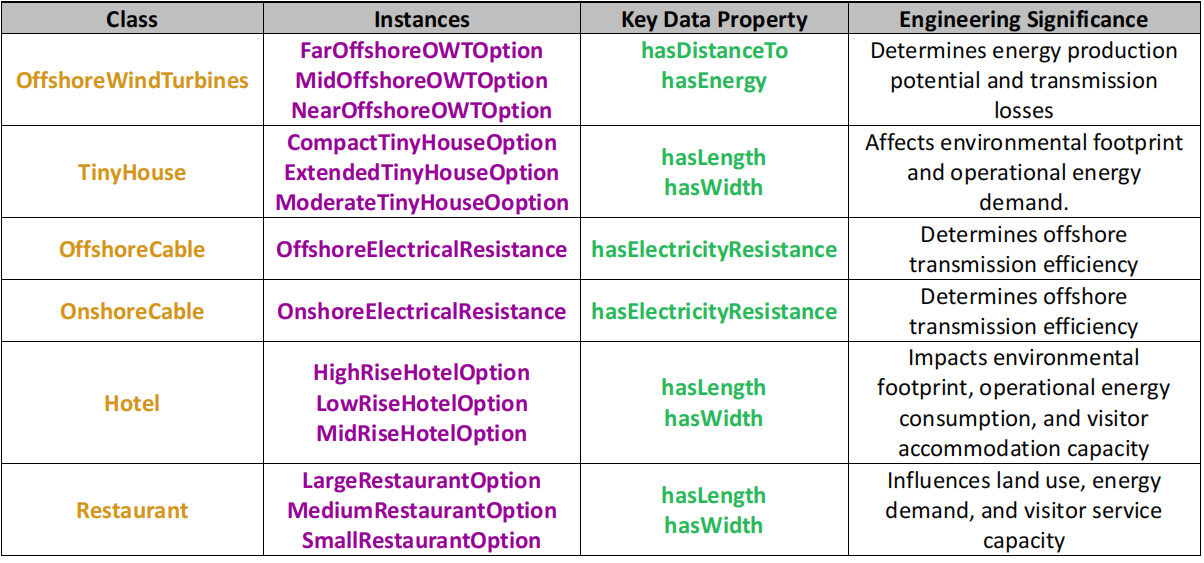
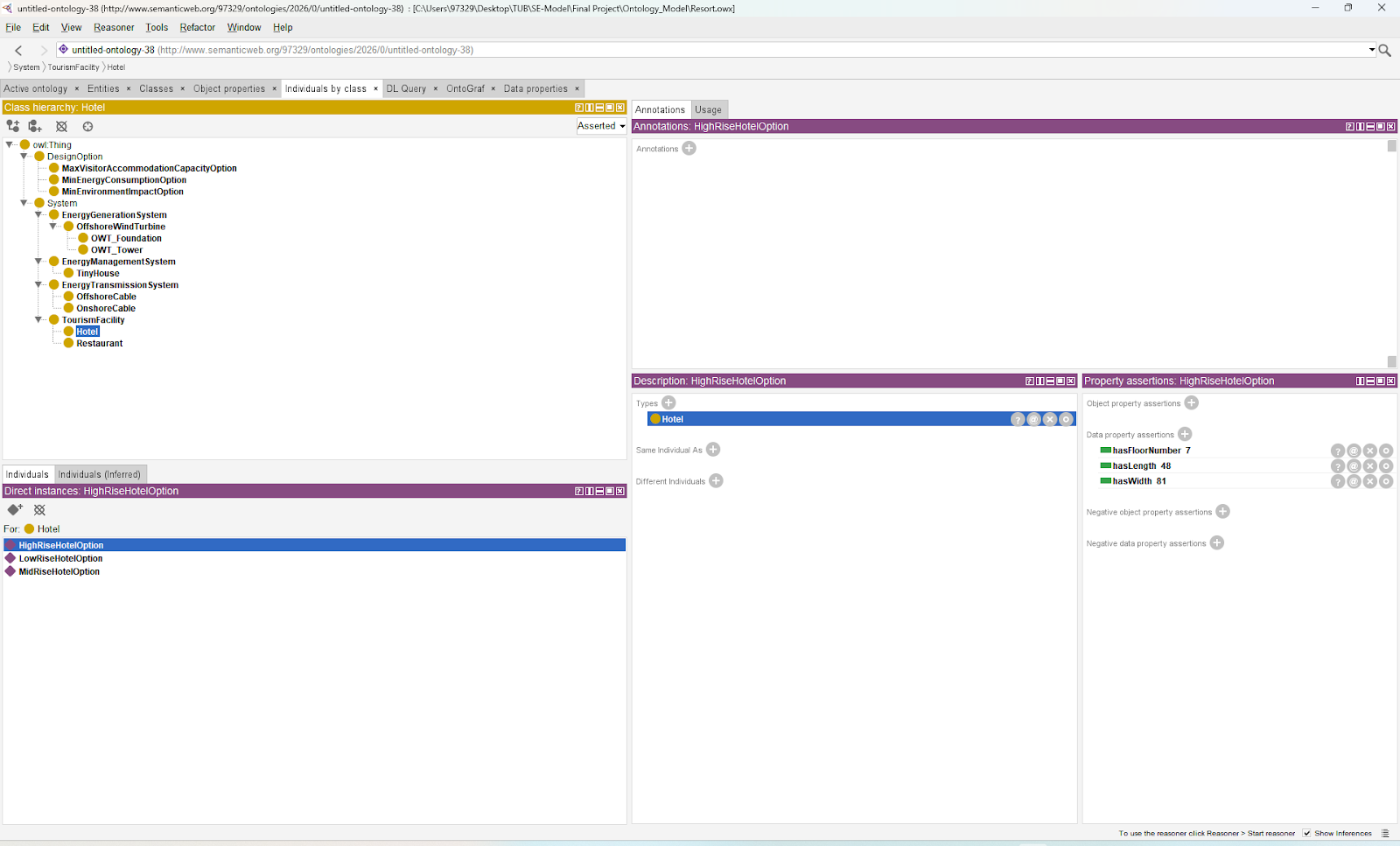
Fig: 3
Design Option
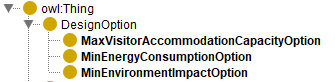
Fig: 4
To enable design reasoning, the ontology introduces a DesignOption class above the structural layer. Operating as a conceptual entity, this class establishes semantic links between system parameters and the HPC, allowing the ontology to evolve from a static structural model into a knowledge framework that supports decision-making.
Based on this, three representative design instances are defined, one of them is shown in Fig.5:
- MaxVisitorAccommodationCapacityOption: This option prioritizes large-capacity Hotel and Restaurant configurations to maximize visitor accommodation capacity.
- MinEnergyConsumptionOption: This option favors high-generation OWT combined with low-energy-demand Building (TinyHouse, Hotel, Restaurant) designs, aiming to achieve maximum energy redundancy and minimal operational energy consumption.
- MinEnvironmentimpactOption: This option emphasizes compact Building footprints to reduce land occupation and minimize ecological disturbance to the island environment.
Through the object property hasSystem and its specialized sub-properties (such as hasCable, hasHotel, and hasOWT), the ontology explicitly represents the component composition associated with each design option (instance selection). This structured representation provides logical support for comparing alternative configurations and evaluating design decisions.
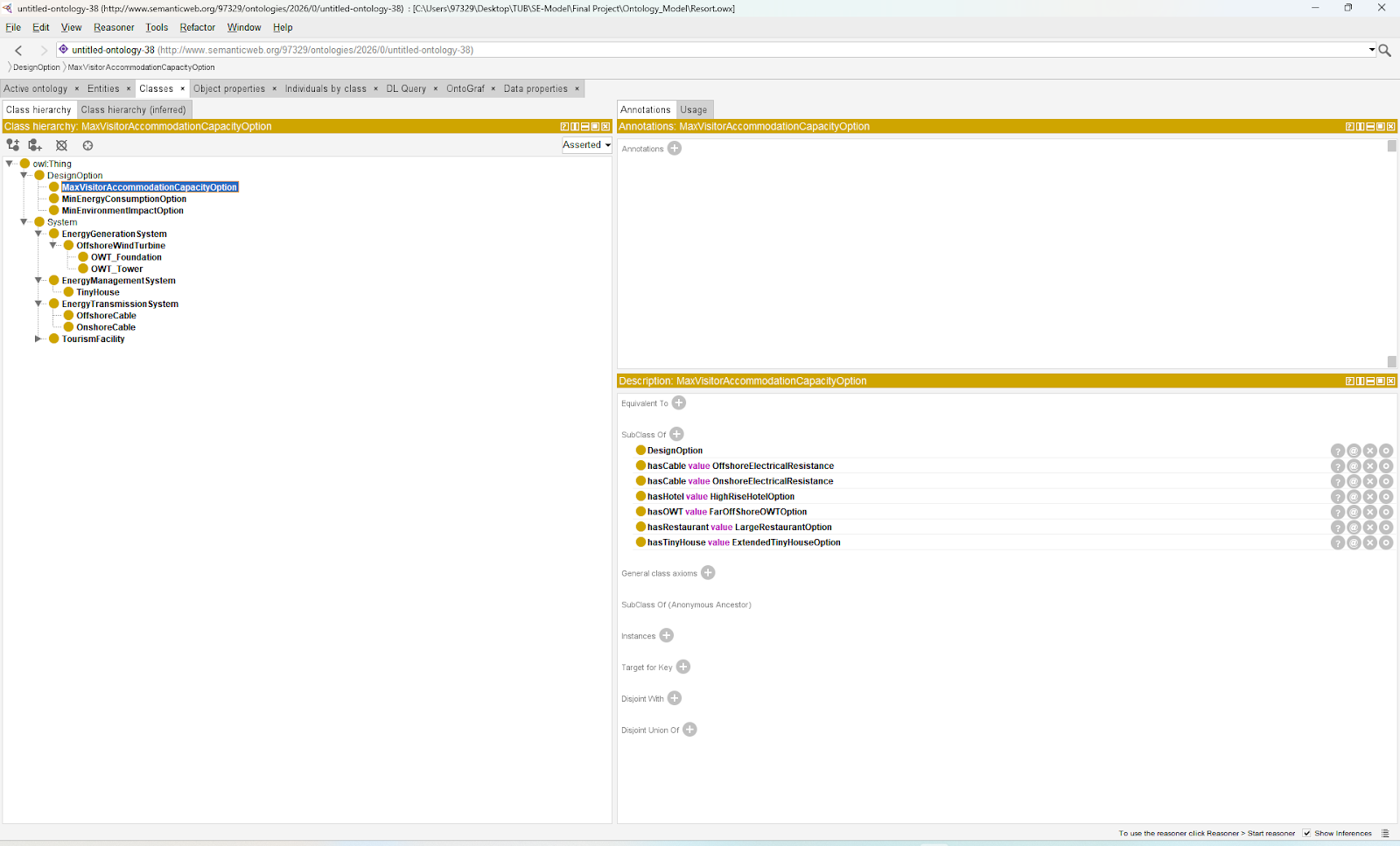
Fig: 5
OntoGraph
OntoGraph, shown in Fig.6, provides a holistic visualization of the ontology’s semantic structure, revealing the multi-level relationships among system components, subsystems, and design options.
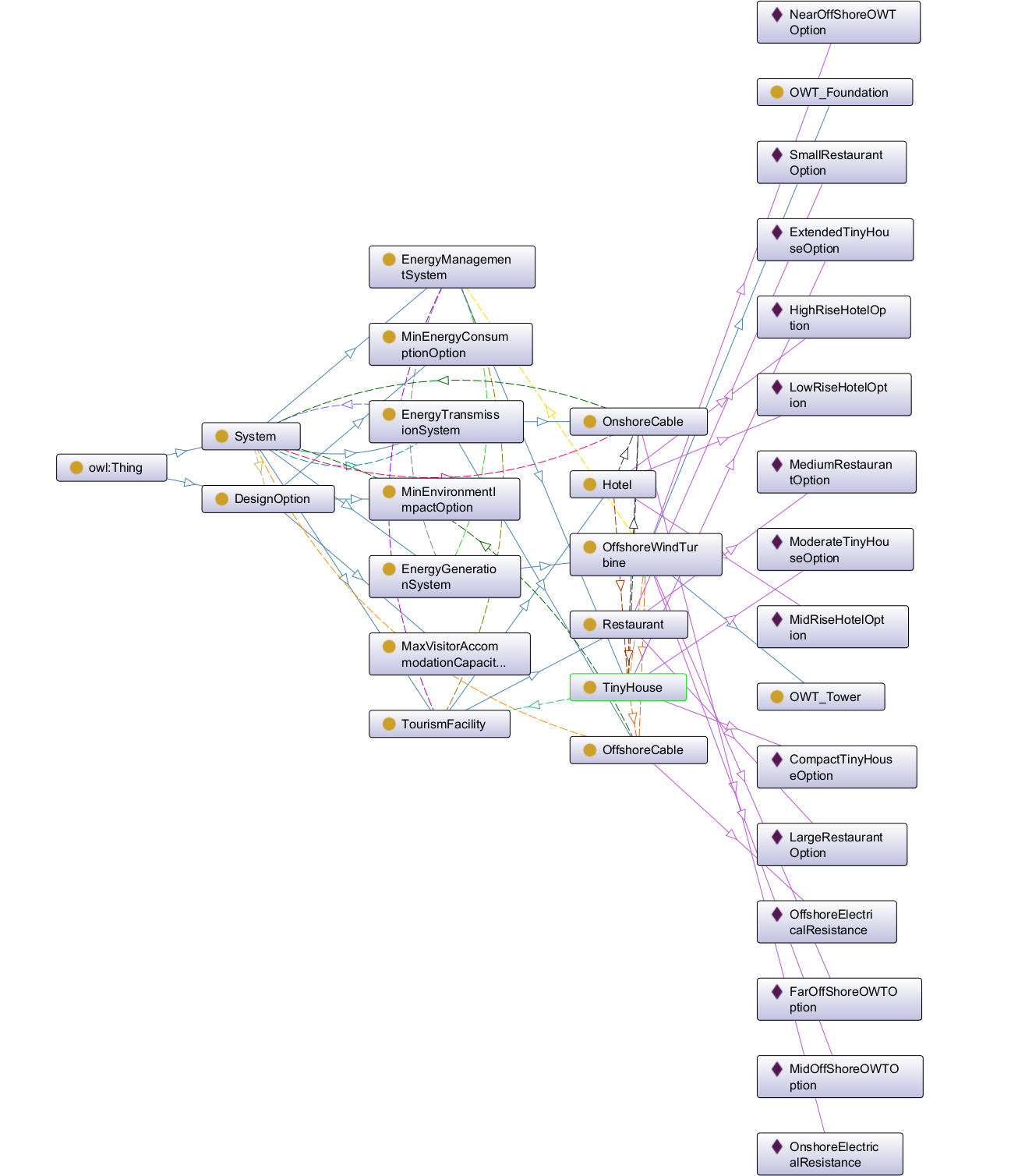
Fig: 6
Conclusion
Overall, the ontology establishes a multi-layered semantic architecture that integrates system representation with performance-driven design reasoning. By linking infrastructure components, spatial parameters, and energy constraints, the model enables holistic system evaluation rather than isolated component analysis.
Consequently, the ontology evolves from a descriptive knowledge structure into an engineering decision-support framework capable of revealing system dependencies, identifying bottlenecks, and explaining design trade-offs.
Engineering Example
1. Integrated Energy Feasibility Check for Island Tourism Development
One engineering application of the ontology is to evaluate whether the island energy system can reliably support the planned tourism facilities under islanded operation. Engineers can query the ontology to identify the relationships between the Offshore Wind Turbine, the energy management Tiny House, and the Hotel and Restaurant as energy consumers.
For example, a key question can be: “Is the electricity generated by the offshore wind turbine sufficient to supply the hotel and restaurant under the current spatial configuration?”
By linking generation capacity, transmission distance, cable loss coefficients, and building energy demand, the ontology enables a structured assessment of power supply reliability. This supports early-stage design decisions by identifying configurations where energy shortages may occur, allowing engineers to adjust building scale, spatial layout, or energy parameters before detailed design.
2. Spatial Layout Optimization under Energy and Environmental Constraints
The ontology can also be used to support spatial planning decisions by linking system components with their geometric locations and environmental constraints. Engineers and planners can analyze how the placement of the offshore wind turbine relative to the island buildings affects both energy transmission losses and environmental impact.
For instance, the ontology enables queries such as: “How does increasing the distance between the wind turbine and the tourism area influence delivered energy and environmental buffer area?”
By explicitly representing spatial relationships, cable systems, and land-use parameters, the ontology helps identify trade-offs between energy efficiency and environmental preservation. This structured representation supports informed decision-making in balancing technical performance with ecological and planning considerations.
3. System-Level Capacity Limitation and Visitor Accommodation Analysis
Another engineering use of the ontology is to determine the maximum number of visitors that the island system can accommodate without compromising power supply reliability. The ontology links building geometry, functional use, and energy consumption to the overall system energy balance.
Engineers can ask: “Which subsystem limits the maximum visitor capacity under islanded operation?”
By connecting hotel and restaurant capacities with their corresponding energy demands, and relating these to available generation and transmission losses, the ontology enables identification of the bottleneck subsystem. This supports system-level reasoning, where visitor accommodation capacity emerges as a constrained outcome rather than a predefined input.
<- Previous Page l Next Page ->