Integrated Background and System Boundary
This project is defined as a self-sufficient offshore island system in which a Hotel, a Restaurant, and a technical equipment building (Tiny House) are integrated within a single, closed system boundary. All electrical energy required for operation is supplied exclusively by one OWT, including its Foundation and Tower. A Cable System was newly introduced to integrate isolated components into a functional energy circuit, connecting the OWT to the island and all island buildings. And the power generation, transmission, and consumption are treated as interdependent processes. All subsystems are evaluated under consistent spatial, environmental, and lifecycle assumptions, forming the basis for the integrated ontological and parametric modeling presented in the following sections.
Integration Logic and Key Interdependencies
Within the defined system boundary, the offshore island is treated as a tightly coupled system where energy infrastructure, buildings, and spatial layout depend on each other. Electrical energy is produced by an offshore wind turbine and distributed through an internal island grid, with no external supply assumed. This means that the available generation capacity and the efficiency of transmission directly limit how the island can operate.
These dependencies are further shaped by structural and spatial constraints. The performance of the wind turbine is influenced by its foundation and tower under offshore environmental loads, while the hotel and restaurant introduce energy demands that vary with occupancy and use. These demands affect the feasible size and configuration of the buildings and, at the same time, define requirements for the energy system. Limited space, exposure to marine conditions, and access for maintenance make it necessary to coordinate decisions on turbine placement, building layout, and infrastructure connections. As a result, structure, energy, function, and space are addressed together as parts of a single civil system.
To understand how these elements transform from individual components into an integrated civil system, several key system interfaces can be identified in Fig.1
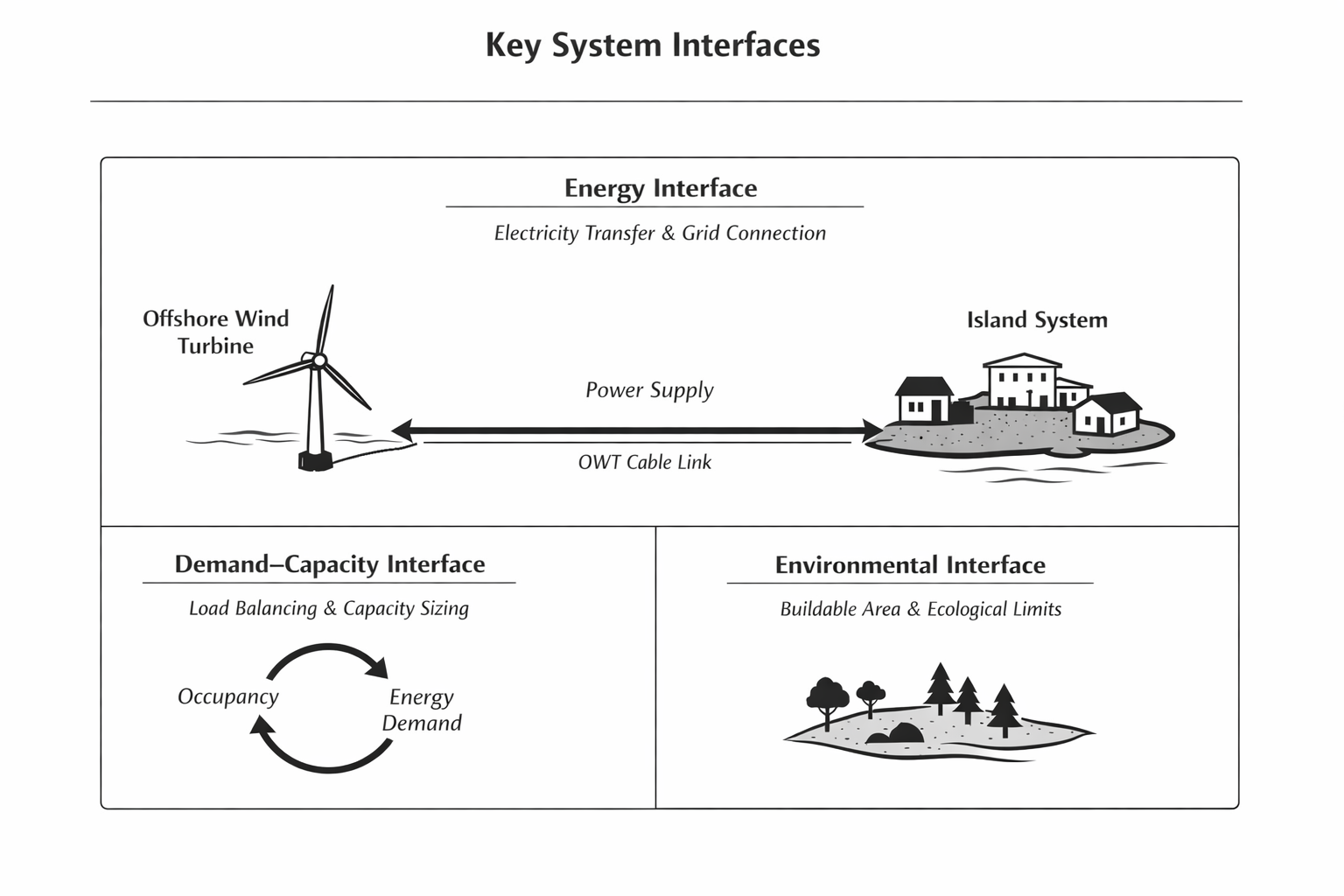
Fig.1
This integration logic forms the basis for the ontological representation of system relationships and the parametric exploration of design alternatives in the following sections.
Engineering Considerations Across Components
When the offshore island is treated as a single integrated civil system, several engineering considerations emerge that apply across all components rather than to individual subsystems. These considerations arise from the shared environmental context, the closed energy boundary, and the interdependence between infrastructure and buildings.
Spatial configuration is a key system-wide consideration. Distances between the offshore wind turbine, energy infrastructure, and buildings influence energy transmission efficiency, environmental impact, and user experience. Decisions regarding placement and layout therefore affect multiple aspects of system performance simultaneously and cannot be addressed independently for each component.
Energy demand represents another central engineering consideration. Building occupancy, usage intensity, and functional programs directly determine system-wide energy requirements and define performance expectations for the energy infrastructure. As a result, energy demand must be considered as an input parameter at the system level rather than as a secondary consequence of architectural design.
Environmental constraints further shape engineering decisions across the island. Requirements related to ecological protection, durability in a marine environment, and long-term operation influence spatial allocation, infrastructure routing, and maintenance accessibility. These constraints apply to the integrated system as a whole and require consistent assumptions across all components.
Together, these engineering considerations define the common framework within which individual systems are designed and evaluated. They provide the basis for identifying design challenges, formulating key parameters, and exploring alternative configurations through ontological and parametric modeling.
Design Challenges and Trade-offs
The integration of the offshore island system introduces several design challenges that arise from conflicting system-level objectives rather than from isolated technical limitations. These challenges emerge precisely because energy infrastructure, buildings, and spatial organization are treated as interdependent elements within a closed system boundary.
One key challenge concerns the spatial placement of the offshore wind turbine relative to the island. Locating the turbine closer to the buildings can reduce transmission distance and associated energy losses, but may introduce negative impacts related to noise and visual presence. Increasing the distance between the turbine and the island mitigates these effects but results in longer transmission routes and reduced energy efficiency. Turbine placement therefore represents a spatial trade-off between environmental and social considerations on the one hand and energy performance on the other.
A second challenge arises from the relationship between occupancy-driven demand and system capacity. The number of guests accommodated on the island is directly linked to energy consumption and economic performance. Higher occupancy improves economic viability but increases energy demand, placing greater pressure on the capacity of a single energy source. Conversely, limiting occupancy reduces energy demand and environmental impact but constrains economic potential. Balancing these opposing effects is a central challenge for the integrated system.
A further challenge is introduced by the conflict between ecological preservation and the island’s economic model. To maximize economic benefits, a larger building footprint is desirable as it increases guest capacity; however, this directly scales with the amount of land sealing (soil hardening) required. Extensive impermeable surfaces significantly increase the environmental footprint and disrupt the existing ecological conditions of the island.
Together, these challenges highlight the necessity of system-level reasoning in the design process. They demonstrate that improvements in one performance dimension often entail compromises in others, and that integration requires explicit consideration of such trade-offs before specific design parameters are selected.
Key Design Parameters for Integration
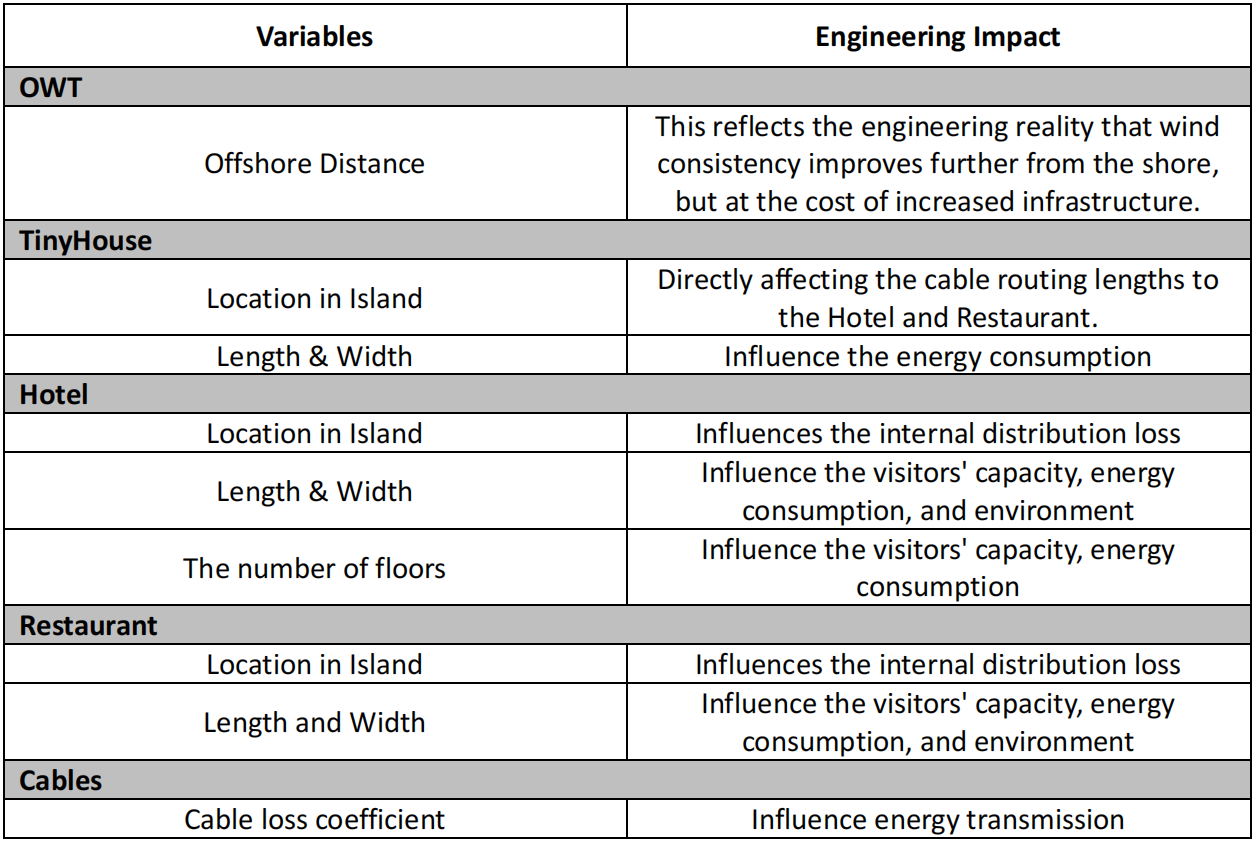
To address the aforementioned challenges and trade-offs, a set of key design parameters has been identified across the sub-systems. These parameters (Table 1) serve as the “input variables” for both the ontological reasoning and parametric simulation.
Table 1
High performance Criteria(HPC)
These three HPC represent inherently competing system objectives and collectively establish a structured framework for evaluating design alternatives, shown in Fig. 2.
1) Visitor Accommodation Capacity (Maximize):
This criterion measures the maximum number of visitors the island system can support while meeting functional requirements and represents the primary concern of island operators. The overall capacity is determined by the minimum shared accommodation among tourism facilities, reflecting the system-level constraint imposed by the bottleneck effect.
2) Power Supply Reliability (Net Positive Energy):
This criterion is jointly prioritized by infrastructure engineers and island operators and aims to ensure the energy self-sufficiency of the islanded microgrid under off-grid conditions. By maintaining a positive energy remainder, the system enhances its resilience against maintenance events, extreme weather, and demand fluctuations, thereby safeguarding operational autonomy and reliability.
3) Environmental Area Ratio (Minimize):
This criterion constrains the ecological impact of resort development by quantifying the ratio between the total building footprint and the overall island area. To protect fragile marine ecosystems, this study[1] recommends that development intensity remain below 5%, ensuring that the majority of the island is preserved as an undisturbed natural buffer zone.
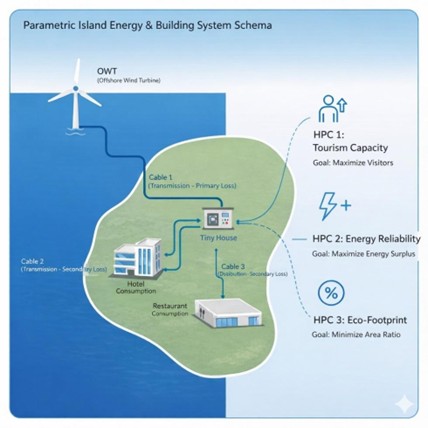
Fig. 2
Reference
[1] United Nations World Tourism Organization. (2013). Sustainable Tourism for Development Guidebook. Madrid, Spain: UNWTO.
[2] Picture Source: AI-generated
<- Previous Page l Next Page ->