Introduction:
Adaptive reuse of historic buildings is essential for sustainable urban development but requires a systematic way to balance structural viability with heritage constraints. This paper presents a formal ontology to address these complex engineering challenges.
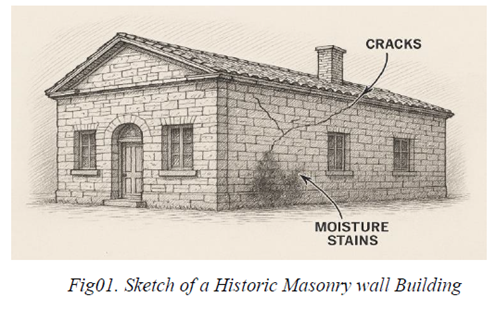
Purpose:
The purpose is to provide a “logical source of truth” for multidisciplinary design teams, allowing for the validation of renovation plans against explicit engineering rules and heritage regulations within an HBIM (Historic Building Information Modelling) framework.
Scope:
The scope focuses on physical building components (Foundations, Masonry Walls), material conditions, observed defects (Findings), and proposed interventions (Strengthening, Moisture Mitigation).
Intended Users & Intended Use:
Users: Multidisciplinary design teams, including structural engineers, heritage consultants, and conservation specialists. Use: The ontology is used for automated consistency checking, structural defect prioritization, and as a reasoning engine to support complex decision-making in digital twin environments.
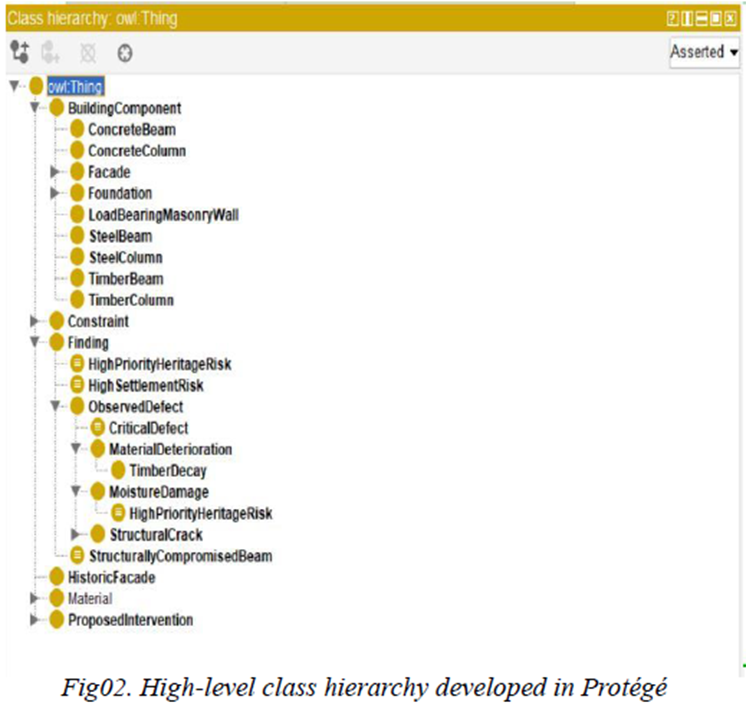
Class Hierarchy:
The hierarchy is decomposed into physical components (BuildingComponent), abstract results from inspections (Finding), constraints (HeritageConstraint), and remedial actions (ProposedIntervention).
Ontograf (Logic & Properties):
The Ontograf view displays the visual ontology network, mapping the relationships between materials, components, and their specific defects or functions.
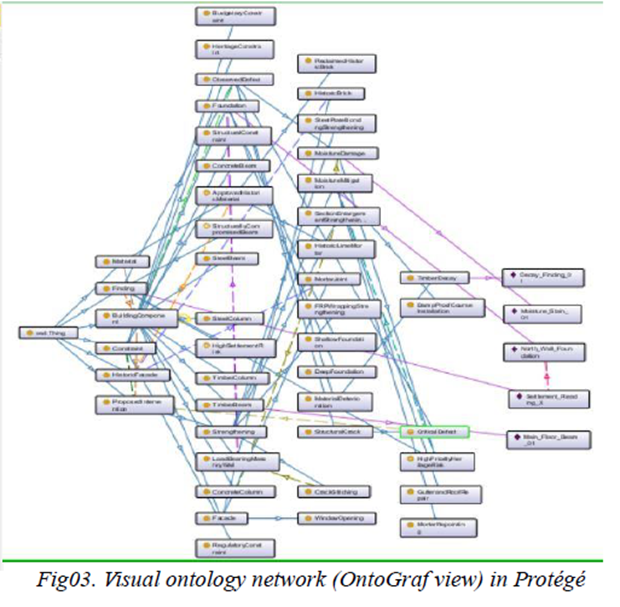
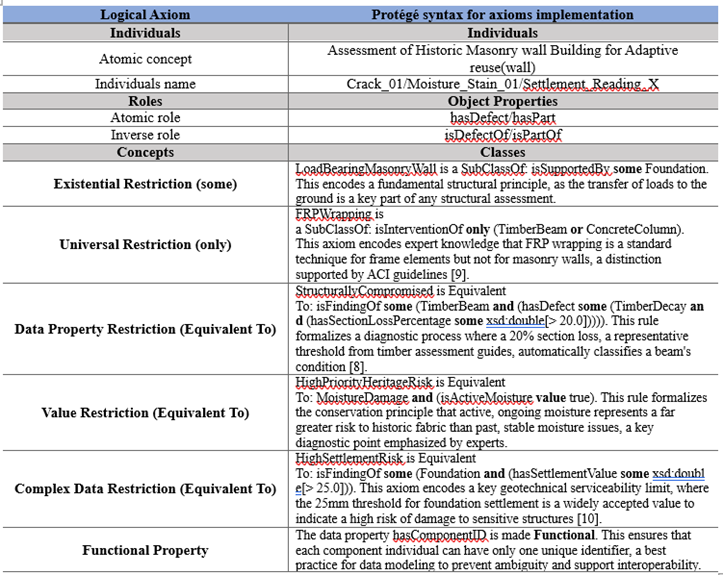
Table01: Table of Axioms
Engineering Examples:
- Automated Defect Prioritization: The system automatically classifies a 6.5 mm crack as a CriticalStructuralDefect because it exceeds the 5.0 mm engineering threshold, immediately flagging the wall for mandatory repairs.
- Guided Moisture Diagnosis: By identifying active damp as a HighPriorityHeritageRisk, the ontology provides a structured checklist of mitigation methods (e.g., roof repair or repointing) to help specialists find the root cause.
- Heritage Compliance Checking: The reasoner prevents damaging mistakes by flagging logical inconsistencies, such as an attempt to repair a historic facade with unapproved modern cement instead of historic mortar.
Conclusion:
The report concludes that formalizing expert knowledge into a logical model transforms the ontology from a simple description into an active reasoning engine, forming the semantic core for a true digital twin in heritage engineering.
References:
1.P. A. Bullen and P. E. D. Love, “Adaptive reuse of heritage buildings: Sustaining the socio-economic and environmental benefits,” Structural Survey, vol. 29, no. 5, pp. 411-422, 2011.
2.C. Dore and M. Murphy, “Historic Building Information Modelling (HBIM),” in Building Information Modeling: BIM in practice, John Wiley & Sons, 2015.
3.Hartmann, T., & Fischer, M. (2007). “Supporting the constructability review process with 4D models.” Journal of Construction Engineering and Management, 133(10), 776-785.
4.ASCE/SEI, “Guideline for Structural Condition Assessment of Existing Buildings (ASCE/SEI 11-99),” American Society of Civil Engineers, Reston, VA, 1999.
5.J. Smith, Conservation of Historic Brick Structures. London, UK: Butterworth-Heinemann, 2018.
6.N. Noy and D. L. McGuinness, “Ontology Development 101: A Guide to Creating Your First Ontology,” Stanford Knowledge Systems Laboratory, Stanford, CA, KSL-01-05, Mar. 2001.
7.M. Krötzsch, F. Simančík, and I. Horrocks, “A Description of the Description Logic OWL 2,” in Reasoning Web. Semantic Technologies for the Web of Data, 2014, pp. 157-210.
8.TRADA (Timber Research and Development Association). (2007). “Assessment of timber structures.” Wood Information Sheet WIS 2/3-37.
9.ACI Committee 440, “ACI 440.2R-17: Guide for the Design and Construction of Externally Bonded FRP Systems for Strengthening Concrete Structures,” American Concrete Institute, 2017.
10.A. W. Skempton and D. H. MacDonald, “The allowable settlements of buildings,” Proceedings of the Institution of Civil Engineers, vol. 5, no. 6, pp. 727-768, 1956.
11.Pauwels, P., Zhang, S., & Lee, Y. C. (2017). “Semantic web technologies in AEC industry: A literature overview.” Automation in Construction, 73, 145-165.