Design Challenge:
In this assignment I focused on developing a simple parametric model of a Perpetual Pavement system using Dynamo. The modeling goal was to explore how changes in layer thicknesses affect two key performance indicators: material usage and fatigue resistance. In perpetual pavements, long-term pavement durability is achieved by optimizing the structure so that critical tensile strains at the bottom of the asphalt layers remain low, reducing fatigue cracking.
To keep the model simple since it was my first time interacting with Dynamo and fully aligned with assignment requirements, the design challenge was restricted to three variable parameters:
- Surface layer thickness
- Intermediate layer thickness
- Fatigue-resistant bottom layer thickness
These parameters directly modify the 3D geometry of the layered pavement and influence two performance metrics:
- Total asphalt volume: a proxy for material usage and cost
- Fatigue Index: a simplified fatigue cracking indicator computed as: FatigueIndex = 1/t(bot)
where is the bottom layer thickness in meters.
(Thicker bottom layer = lower index = better fatigue performance.)
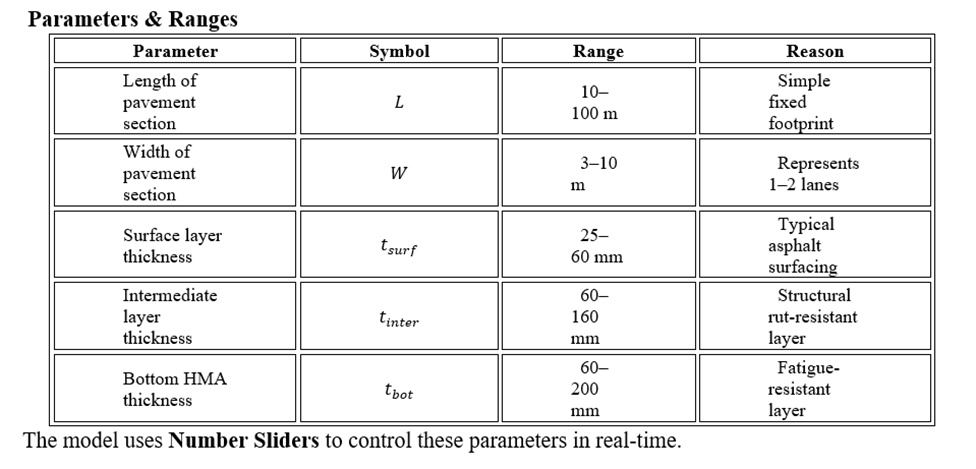
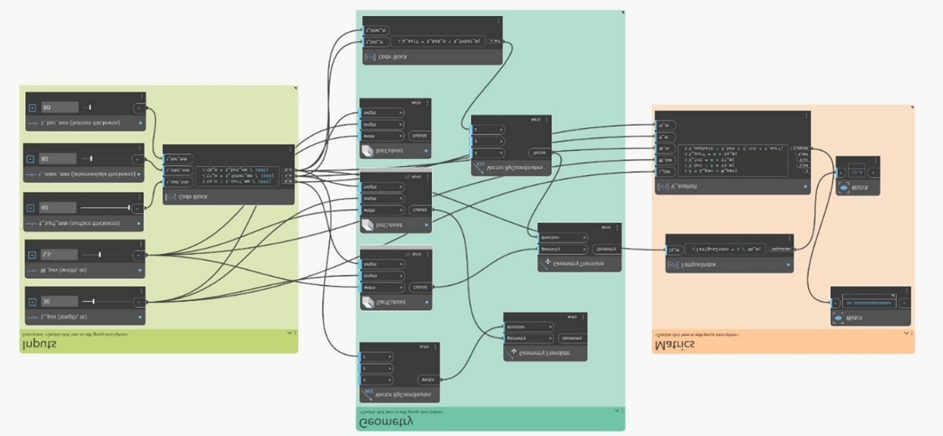
Fig1. Dynamo nodes divided into three grouped functionalblocks
- Inputs Block
Contains the parameter sliders and a Code Block converting thickness from mm → m:
B. Geometry Block
Creates the layered pavement model using three stacked Cuboid.ByLengths nodes representing:
- Bottom asphalt layer
- Intermediate asphalt layer
- Surface layer
Each cuboid is translated vertically based on accumulated thickness. These translations create a visually accurate, stacked pavement structure.
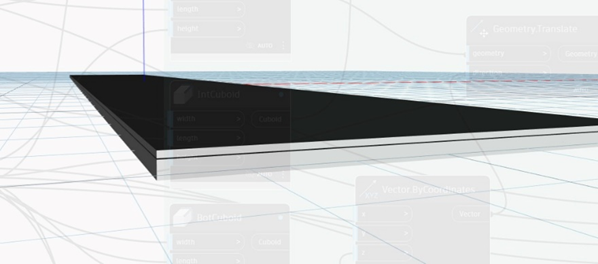
Fig2. Dynamo model of Pavement
C. Metrics Block
Two performance indicators are computed:
- Total Asphalt Volume
- Fatigue Index
Two Watch nodes were also added show numerical results in real time.
Design Space Extremes:
To analyze the system, the sliders were moved to minimum and maximum values.
Thin Design (Minimum Values)
- t_surf = 25 mm
- t_inter = 60 mm
- t_bot = 60 mm
Observations:
- V_asphalt is very low → material/cost efficient
- FatigueIndex is high → poor fatigue performance
Thick Design (Maximum Values)
- t_surf = 60 mm
- t_inter = 160 mm
- t_bot = 200 mm
Observations:
- V_asphalt is very high
- FatigueIndex is very low → excellent fatigue performance
Good Design Alternatives:
Based on visual clarity and metric evaluation, three promising designs were selected.
Alternative A – High Durability (Heavy Traffic)
| Parameter | Value |
| t_surf | 50 mm |
| t_inter | 140 mm |
| t_bot | 160 mm |
Why it’s good:
- Low fatigue index
- Thick bottom layer ensures excellent durability
- Slightly higher volume, acceptable for heavily trafficked routes
Alternative B – Balanced (General Urban Use)
| Parameter | Value |
| t_surf | 40 mm |
| t_inter | 110 mm |
| t_bot | 120 mm |
Why it’s good:
- Balanced volume vs fatigue performance
- Reasonable material cost
- Suitable for typical urban highways
Alternative C – Material-Efficient (Cost-Sensitive)
| t_surf | 35 mm |
| t_inter | 90 mm |
| t_bot | 100 mm |
Why it’s good:
- Significantly lower volume
- Acceptable fatigue performance for moderate traffic
- Best option when minimizing cost is critical.