Introduction:
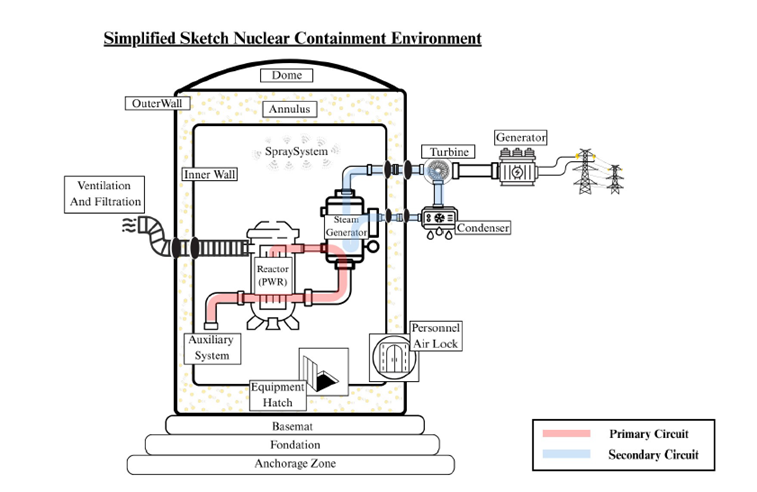
The nuclear containment building is a critical safety structure designed to confine radioactive substances and protect the environment from internal pressures or external attacks.
Purpose:
To provide a modular model that maps the interactions between physical components, safety functions, and materials, aiding in the design and comparison of various nuclear plant configurations.
Scope:
Covers the physical superstructure (walls, dome), substructure (foundation), auxiliary safety systems (spray, ventilation), and functional requirements like radiation shielding and leak-tightness.
Intended Users & Intended Use:
Users: Civil engineers, nuclear safety researchers, and plant designers. Use: To enable “what-if” scenarios for different reactor types (PWR vs. BWR or Fission vs. Fusion) and to facilitate the selection of materials based on regulatory and environmental constraints.
Class Hierarchy:
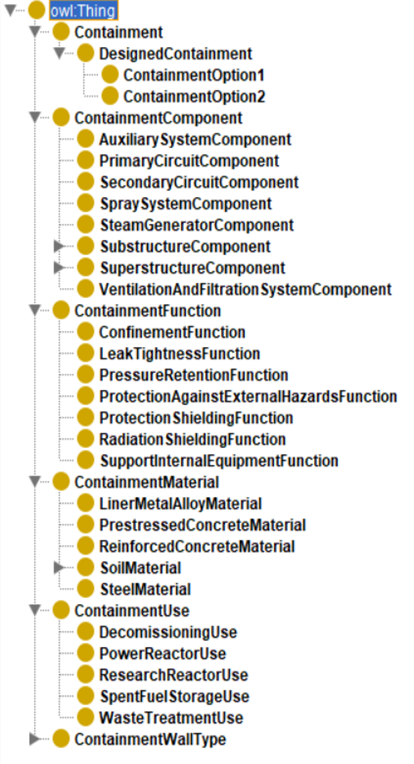
The ontology is organized into several main branches:
1.ContainmentComponent: Includes Superstructure, Substructure, and Auxiliary systems.
2.ContainmentFunction: Covers leak-tightness, radiation shielding, and pressure retention.
3.ContainmentMaterial: Includes specific materials like prestressed concrete, liner metal alloys, and various soil types.
4.ContainmentUse: Defines the plant’s purpose (e.g., Power Reactor, Research, Waste Treatment).
Ontograf (Logic & Axioms):
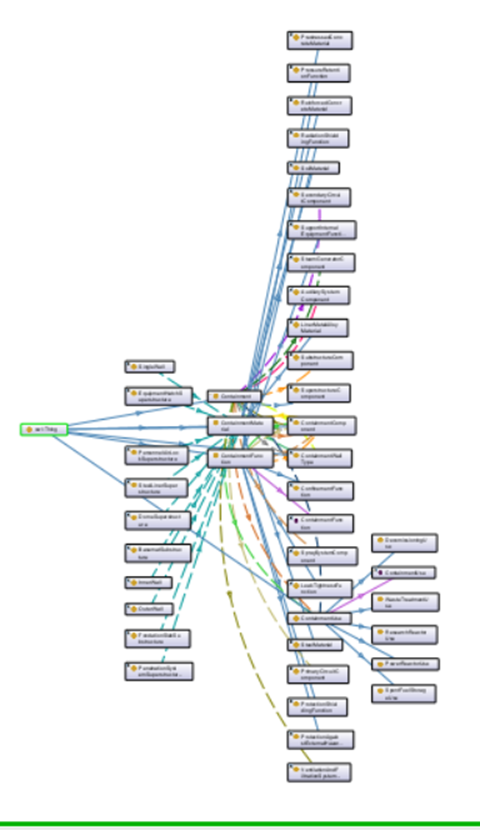
A) Wall Logic: A WallSuperstructure must have exactly one wall type (Single or Double). If it is a DoubleWall, it must contain an InnerWall, OuterWall, and Annulus.
B) Object Properties: The model defines transitive properties like hasComponent and isComponentOf, and maps functions to specific components (e.g., DomeSuperstructure has the function to EnsurePressureRetention).
Engineering Examples:
- Fusion vs. Fission: Comparing a standard fission reactor to a Tokamak (fusion) vessel to identify different shielding requirements.
- Environmental Adaptation: Using the ontology to swap traditional concrete for low-carbon alternatives to meet new environmental regulations.
- Seismic Integration: Modeling the addition of a Tuned Mass Damper (TMD) to evaluate how it interacts with the existing internal volume and vibration modes.
Conclusion:
The ontology provides a robust framework for documenting safety requirements and structural dependencies. It allows designers to automatically integrate material and geometric choices into parametric models for further mechanical and environmental simulation.
References:
1.Evolution of nuclear reactor containments in India: Addressing the present day challenges, A. Kakodkar, 2014
2.Thermal-Hydraulic comparative analysis of G-III+BWR and PWR passive safety features under Loss of coolant accident, X. Zhang et al., 2023
3.Chapter 4 «Design Requrement», Safety Series No.50-SG-D12 Design of Reactor Containment Systems in Nuclear Plants A Safety Guide, 1985
4.Section 4 «Engineering Design, Fabrication, Erection and Testing», Nuclear Reactor Containment Buildings And Pressure Vessels, The Royal College Of Science & Technology, Glasgow, 1960
5.Section 2 «Design Studies And Methods Of Stress Analysis», Nuclear Reactor Containment Buildings And Pressure Vessels, The Royal College Of Science & Technology, Glasgow, 1960
6.Strain Monitoring and Numerical Simulation Analysis of Nuclear Containment Structure During Containment Tests, X/Yin et al., 2025
7.Pre-conceptual design of prestressed concrete containment for a GFR nuclear reactor, Petr Bílý et al., 2025
8.Stochastic finite elements analysis of large concrete structures’ serviceability under thermo-hydro-mechanical loads – Case of nuclear containment buildings, D.E.-M. Bouhjiti et al., 2020
9.Enciente de confinement pour un reacteur a eau lourde-gaz de 250 MWe, Verstraete et al., 1967
10.A novel computational framework for efficient nuclear containment design: Structural integrity, radiation shielding, and reliability assessment, S.Saxena et al., 2025