1. Introduction of the System
Urban asphalt pavement systems are critical components of transportation infrastructure, providing mobility, economic connectivity, and safety. These systems are continuously exposed to traffic loading, environmental effects, material aging, and construction uncertainties, which lead to progressive deterioration over time. Unlike short-term performance evaluations, pavement systems must be assessed over their entire service life to understand long-term reliability, sustainability, and economic efficiency.
This integrated system study combines probabilistic deterioration modelling, risk-based reliability assessment, and life-cycle sustainability analysis. The system is evaluated over a 40-year design life for a functional unit of 1 km long and 3.5 m wide asphalt lane, which allows consistent comparison across performance, environmental, and cost dimensions.
The merged framework integrates:
- Markov Chain deterioration modeling to represent condition evolution,
- Fault Tree Analysis (FTA) to capture failure mechanisms,
- Life-Cycle Assessment (LCA) for environmental impacts,
- Life-Cycle Cost Analysis (LCCA) for economic evaluation, and
- Multi-Criteria Decision Analysis (AHP) for optimal material selection.
This system-level approach reflects real-world pavement management practices and supports evidence-based infrastructure decision-making.
2. System Description and Functional Unit
The asphalt pavement system is defined as:
- Length: 1 km
- Width: 3.5 m
- Surface layer: 4 cm
- Binder/Base layer: 8 cm
- Design life: 40 years
This functional unit is consistently used across both assignments to ensure comparability of deterioration behavior, maintenance strategies, emissions, and costs.
System Boundary
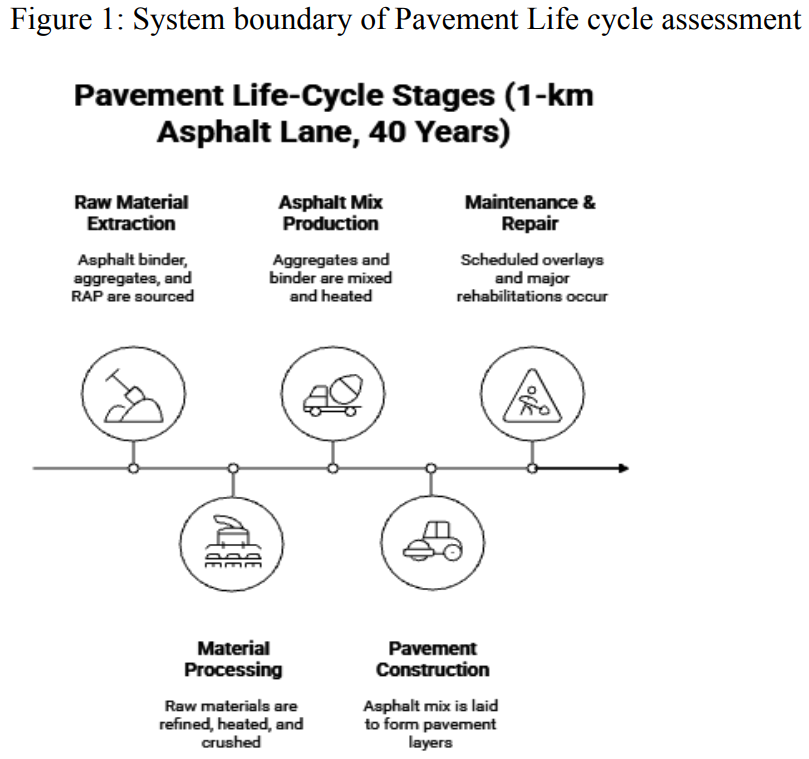
The system boundary follows a cradle-to-maintenance approach:
- Raw material extraction
- Asphalt production and processing
- Pavement construction
- Scheduled maintenance and rehabilitation
Excluded processes include subbase, traffic management, and end-of-life activities, as these are assumed equal for all alternatives.
- System Boundary of Pavement Life-Cycle Assessment
3. Pavement Deterioration and Reliability Modeling
3.1 Markov Chain Deterioration Model
Pavement deterioration is a stochastic process influenced by uncertain loading, environmental exposure, and material behavior. To capture this uncertainty, a Markov Chain model is used, where pavement condition transitions probabilistically between discrete states ranging from Excellent (9) to Failure (0).
Each year, the pavement may remain in its current condition or transition to a worse state based on predefined probabilities derived from literature and pavement management guidelines.
Table-Pavement Condition States
| Rating | Condition | Typical Action |
|---|---|---|
| 9 | Excellent | No action |
| 8 | Very Good | Routine inspection |
| 7 | Good | Crack sealing |
| 6 | Satisfactory | Surface treatment |
| 5 | Fair | Thin overlay |
| 4 | Poor | Major overlay |
| 3 | Serious | Immediate rehabilitation |
| 2 | Critical | Traffic restriction |
| 1 | Immediate Fail | Full depth repair |
| 0 | Failure | Reconstruction |
3.2 Probability Evolution of Pavement Condition
Using the Markov transition matrix, the probability of being in each condition state is simulated over 40 years. Results show slow deterioration in early years and rapid degradation after mid-life if maintenance is not applied.
- Asphalt Pavement System – Probability of States Over 40 Years
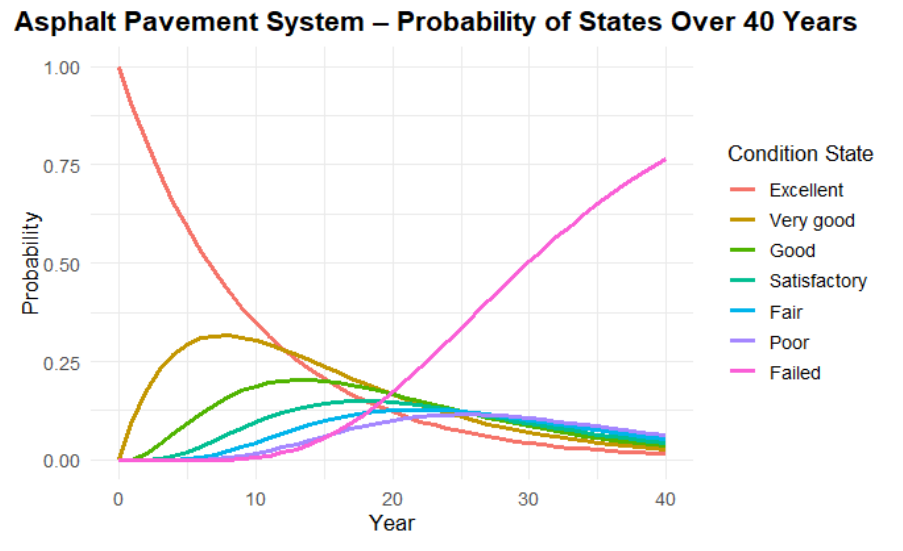
This graph visually demonstrates why proactive maintenance is critical for extending pavement service life.
4. Failure Risk and Fault Tree Analysis
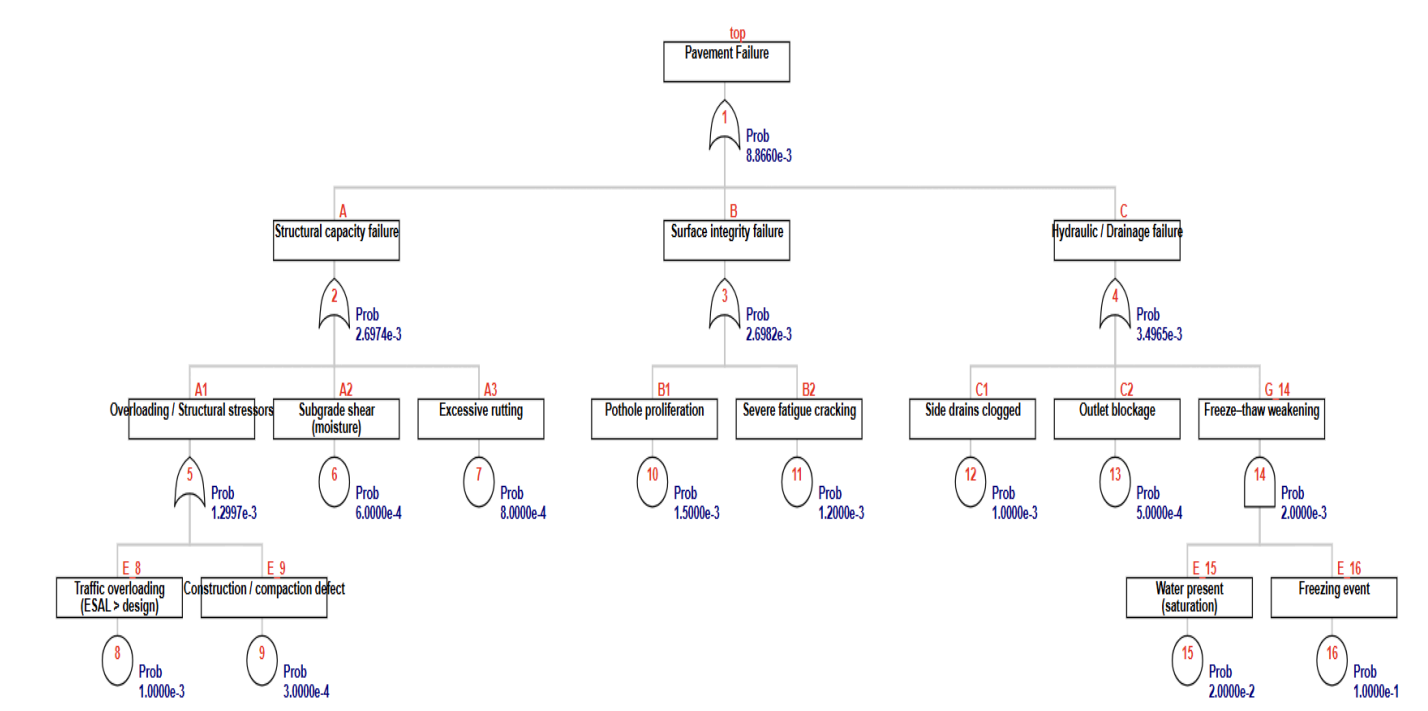
While Markov models describe gradual deterioration, sudden failures require a different approach. Fault Tree Analysis (FTA) is used to model system-level failure probability.
Failure Mechanisms
Top event: Pavement Failure, caused by:
- Structural capacity failure
- Surface integrity failure
- Hydraulic/drainage failure
Each failure path is decomposed into basic events such as overloading, rutting, poor compaction, drainage blockage, and freeze-thaw damage.
- Fault Tree Diagram for Pavement Failure
5. Maintenance Strategy and Life-Cycle Timeline
Maintenance activities restore pavement condition and slow deterioration. Two intervention types are considered:
- Thin Overlay (TO) – surface restoration
- Major Overlay (MO) – deep rehabilitation
Intervention Schedules
| Option | Thin Overlay Years | Major Overlay Year |
|---|---|---|
| HMA | 12, 24, 36 | 28 |
| PMA | 16, 32 | 32 |
| RAP | 12, 24, 36 | 28 |
- Timeline of Maintenance Interventions (40 years)
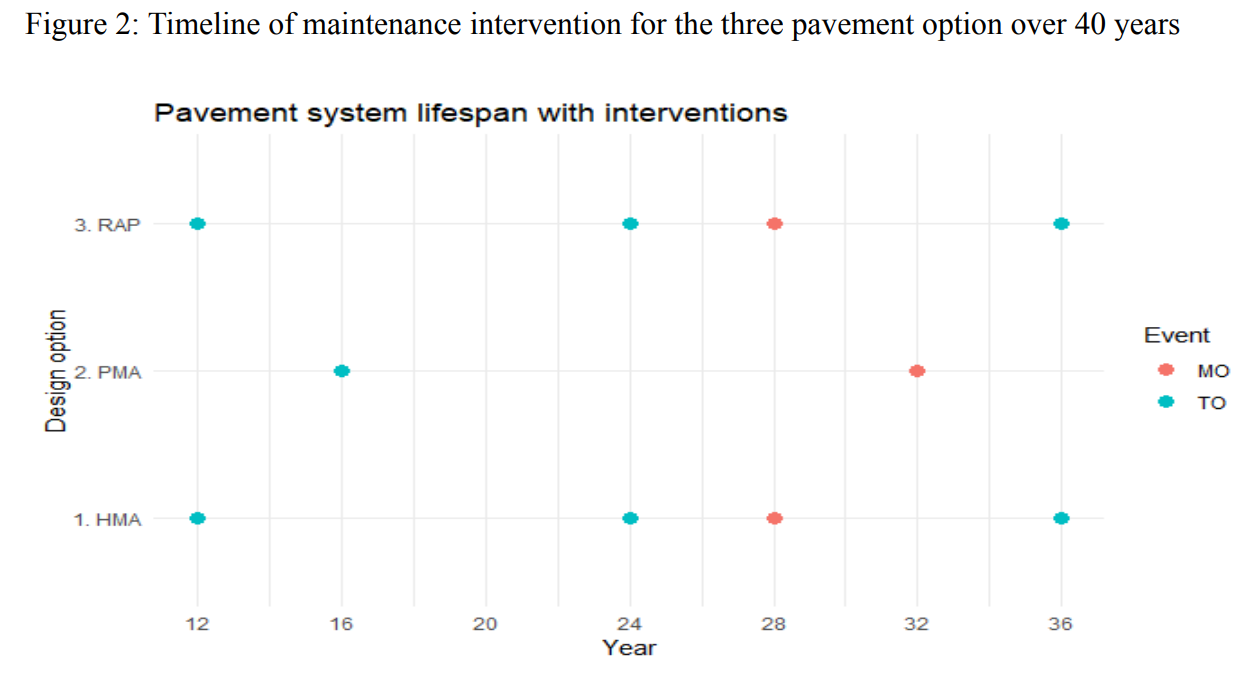
This timeline explains why durability-enhanced materials reduce intervention frequency.
6. Life-Cycle Inventory and Environmental Impact Assessment
The Life-Cycle Inventory (LCI) quantifies energy use and emissions for all construction and maintenance activities.
Environmental Indicators
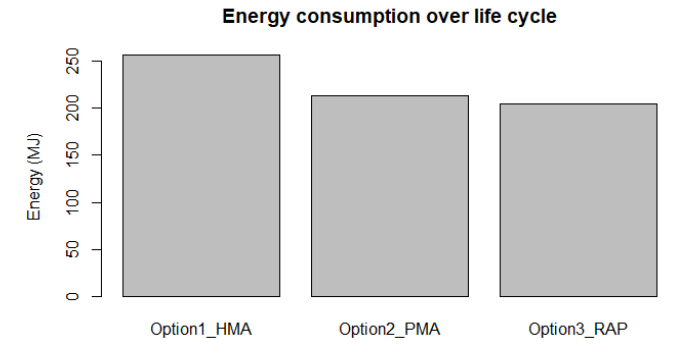
- Cumulative Energy Demand
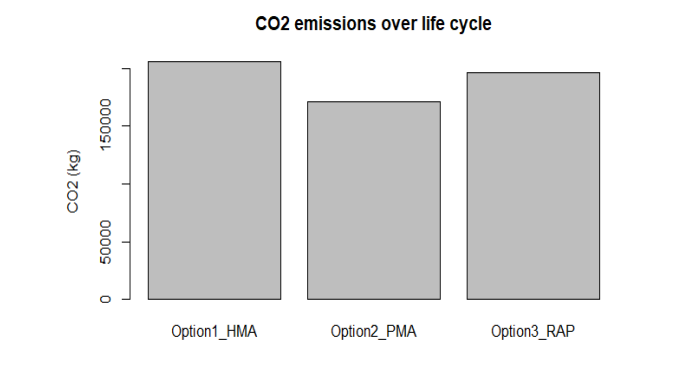
- CO₂ emissions
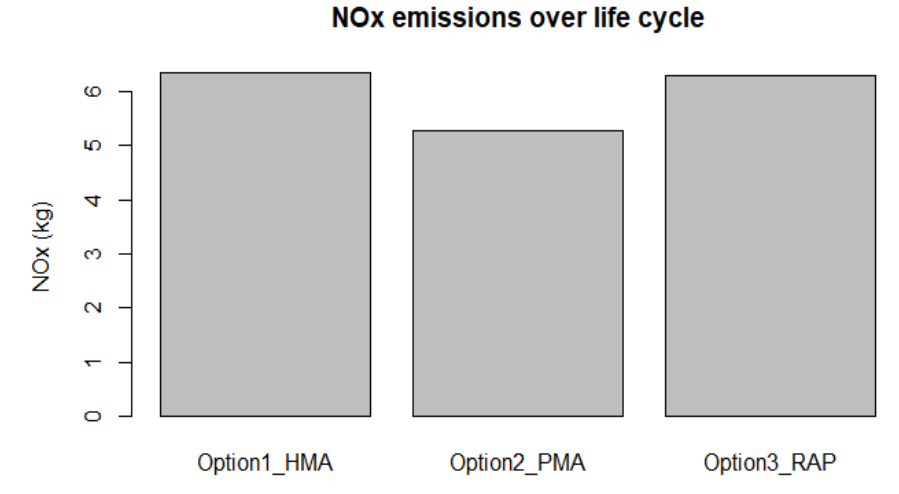
- NOₓ emissions
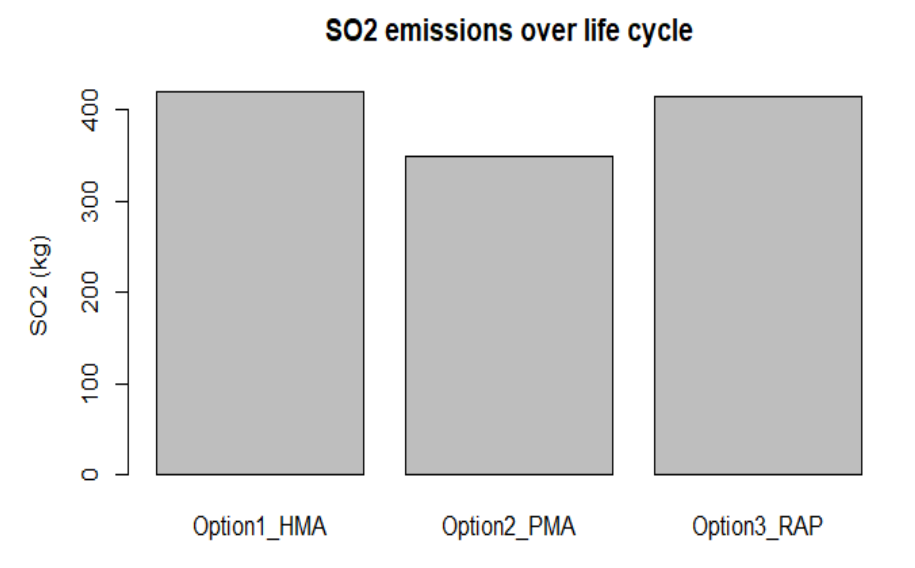
- SO₂ emissions
Results Summary Table
| Option | Energy (MJ) | CO₂ (kg) | NOₓ | SO₂ |
|---|---|---|---|---|
| HMA | 255.9 | 205,800 | 6.34 | 419 |
| PMA | 213.3 | 171,500 | 5.29 | 349 |
| RAP | 204.8 | 196,560 | 6.29 | 414 |
- Energy consumption
- CO₂ emissions
- NOₓ emissions
- SO₂ emissions
7. Life-Cycle Cost Analysis (LCCA)
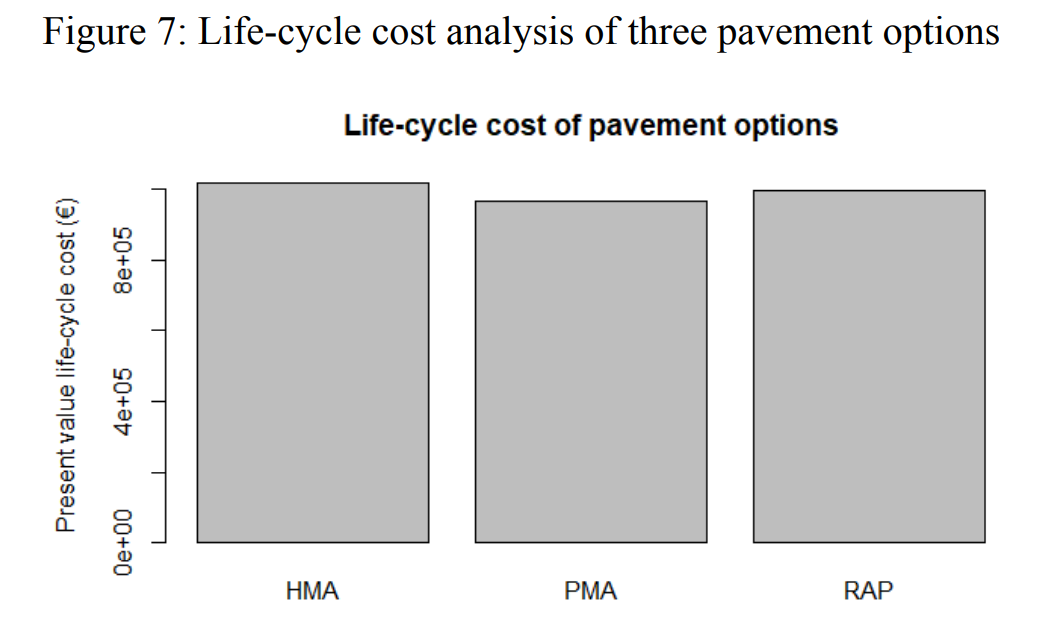
LCCA evaluates total discounted costs over 40 years using a 3% discount rate.
Cost Results
- Lowest cost: PMA (€967,890)
- RAP cheaper than HMA due to recycled materials
- HMA highest cost due to frequent interventions
- Life-Cycle Cost Comparison
8. Multi-Criteria Decision Analysis (AHP)
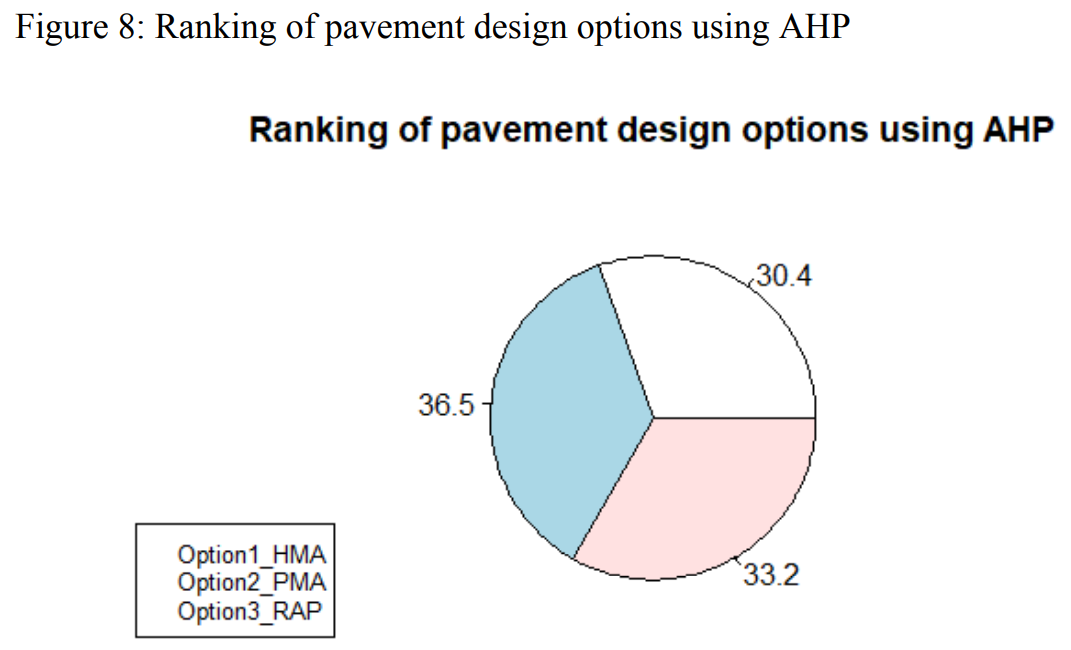
To integrate environmental and economic performance, the Analytic Hierarchy Process (AHP) is applied.
Criteria
- Energy
- CO₂
- NOₓ
- SO₂
- Life-Cycle Cost
Final Ranking
| Option | Weight (%) |
|---|---|
| PMA | 36.5 |
| RAP | 33.2 |
| HMA | 30.4 |
- AHP Ranking of Pavement Options
9. Engineering Discussion
The integrated system analysis shows that maintenance frequency dominates sustainability performance. PMA outperforms other options not because of lower initial impacts, but because enhanced durability significantly reduces resurfacing events. RAP provides material sustainability benefits, but without durability improvement, these gains are partially offset. HMA remains reliable but environmentally and economically inferior over a long service life.
10. Conclusion
By merging reliability modelling with life-cycle sustainability and decision analysis, this study demonstrates that long-term performance improvement is the most effective strategy for sustainable pavement systems. PMA emerges as the optimal solution when environmental impact, cost, and reliability are jointly considered.
References:
- ISO. (2006). ISO 14040:2006 — Environmental management: Life cycle assessment — Principles and framework. International Organization for Standardization, Geneva.
- ISO. (2006). ISO 14044:2006 — Environmental management: Life cycle assessment — Requirements and guidelines. International Organization for Standardization, Geneva.
- Harvey, J. T., Meijer, J., Ozer, H., Al-Qadi, I. L., Saboori, A., & Kendall, A. (2016). Pavement Life-Cycle Assessment Framework (FHWA-HIF-16-014). Federal Highway Administration (FHWA), U.S. Department of Transportation.
- Walls, J., & Smith, M. R. (1998). Life-Cycle Cost Analysis in Pavement Design: Interim Technical Bulletin (FHWA-SA-98-079). Federal Highway Administration (FHWA), U.S. Department of Transportation.
- ASTM International. (2021). ASTM E1926-08(2021): Standard Practice for Computing International Roughness Index (IRI) of Roads from Longitudinal Profile Measurements. ASTM International.
- Burr, A. A., Shahin, M. Y., Feighan, K. J., & Carpenter, S. H. (1987). Pavement performance prediction model using the Markov process. Transportation Research Record, 1123.
- IEC. (2006). IEC 61025:2006 — Fault tree analysis (FTA). International Electrotechnical Commission, Geneva.
- Saaty, T. L. (1980). The Analytic Hierarchy Process: Planning, Priority Setting, Resource Allocation. McGraw-Hill, New York.
- Saaty, R. W. (1987). The analytic hierarchy process—what it is and how it is used. Mathematical Modelling, 9(3–5), 161–176.
- Transportation Research Board (TRB), NCHRP. (2004). NCHRP Report 523: Optimal Timing of Pavement Preventive Maintenance Treatment Applications. National Academies Press, Washington, DC.