Focus
This assignment investigates glass curtain wall facade systems as complex, non-load-bearing building envelopes, emphasizing their structural composition, material behavior, and performance roles in modern high-rise buildings.
Objective
The primary goal was to develop an ontology that formalizes facade components, materials, and functional performance attributes in order to support comparative evaluation of facade design options, particularly with respect to sustainability and environmental performance.
Method
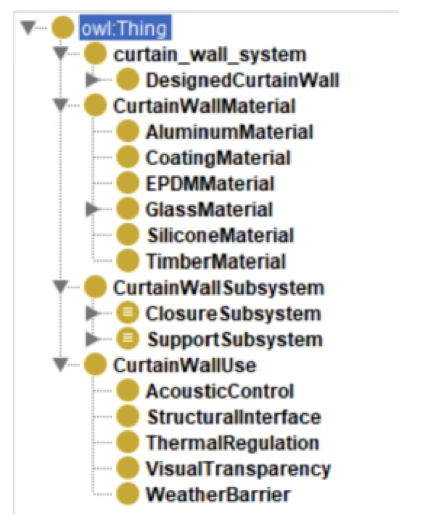
An ontology was developed to structure curtain wall knowledge across physical components, material classifications, and functional roles such as thermal regulation, acoustic control, and weather protection. Multiple facade configurations—including single-glazed, double-glazed, and low-carbon hybrid systems—were instantiated and compared using performance-related data properties such as U-value, sound insulation, transparency, and embodied carbon.
Outcome & Relevance
The ontology demonstrates how facade systems can be evaluated as knowledge-based design alternatives rather than isolated assemblies. It provides a scalable framework for sustainability-oriented facade design and offers strong potential for integration with BIM workflows, digital twins, and performance-driven architectural decision-making.